
BNSullivan.jpg) [Click photo for larger view.]
[Click photo for larger view.]BNSullivan.jpg "Christmas Tree Worm (Spirobranchus giganteus)")
Male fur seals at Taiaroa Head
We spent two days exploring the Otago Peninsula, outside the city of Dunedin on New Zealand's South Island. On the second day there we visited a small cove called Pilot's Beach, a small crescent of sand bordered by a jumble of rocks on each side. The cove is situated on the sheltered side of Taiaroa Head, the wildlife reserve at the tip of the peninsula.
We saw Blue Penguin burrows near the beach, but not the penguins themselves since we were there during the bright midday hours. The penguins only come ashore at dusk to spend the night in their nests, returning to the sea again at first light.
We did get to see several good-sized male New Zealand Fur Seals (Arctocephalus forsteri). While we had seen some female fur seals sunning themselves at Kaikoura the week before, this was the first time we had seen the larger males of the species.
Several of these guys were swimming rather close to shore. We sat on the rocks beside the beach for quite awhile so we could watch them. We were surprised to see them lazily swimming on their backs at times, sort of lolling about, paddling just a bit with their front flippers, while their back flippers poked up above the water's surface. Unfortunately they did this too far offshore to photograph clearly, since I didn't have a telephoto lens.
Then one seal seemed to notice us, and swam toward the rocks where we sat, as if he had decided to have a look at us.
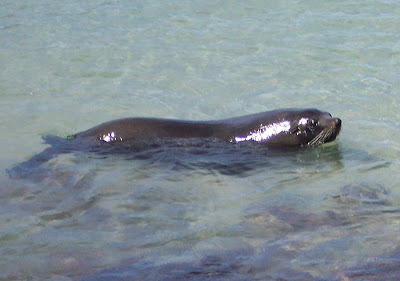
He made one pass, and then swam seaward for a bit before circling back to inspect us again. We didn't move (except to raise the camera). This time the seal came even closer, paused right in front of us, and raised his head out of the water for a better look at the strange jeans-clad mammals sitting on the rocks.

He stayed there for a few minutes, just staring at us. We stared back! He came in just a bit closer, and we began to wonder if he was going to haul out right onto the rocks where we were sitting.
 But no -- in the end, he just rolled over onto his back and swam away from shore. We were sorry to see him go back out to sea, but we were grateful to have had such a great close encounter with this very photogenic marine mammal.
Not too far away, there is a fur seal breeding colony populated by females and a few dominant males. Those older males are very territorial and do not appreciate interlopers. They will challenge and fight younger males who intrude at the colony.
We were told that the fur seals we saw in the Pilot's Beach area are mostly younger males who come to the area to rest in the sheltered cove, away from the threat of the older males.
We saw Blue Penguin burrows near the beach, but not the penguins themselves since we were there during the bright midday hours. The penguins only come ashore at dusk to spend the night in their nests, returning to the sea again at first light.
We did get to see several good-sized male New Zealand Fur Seals (Arctocephalus forsteri). While we had seen some female fur seals sunning themselves at Kaikoura the week before, this was the first time we had seen the larger males of the species.
Several of these guys were swimming rather close to shore. We sat on the rocks beside the beach for quite awhile so we could watch them. We were surprised to see them lazily swimming on their backs at times, sort of lolling about, paddling just a bit with their front flippers, while their back flippers poked up above the water's surface. Unfortunately they did this too far offshore to photograph clearly, since I didn't have a telephoto lens.
Then one seal seemed to notice us, and swam toward the rocks where we sat, as if he had decided to have a look at us.

He made one pass, and then swam seaward for a bit before circling back to inspect us again. We didn't move (except to raise the camera). This time the seal came even closer, paused right in front of us, and raised his head out of the water for a better look at the strange jeans-clad mammals sitting on the rocks.

He stayed there for a few minutes, just staring at us. We stared back! He came in just a bit closer, and we began to wonder if he was going to haul out right onto the rocks where we were sitting.
 But no -- in the end, he just rolled over onto his back and swam away from shore. We were sorry to see him go back out to sea, but we were grateful to have had such a great close encounter with this very photogenic marine mammal.
Not too far away, there is a fur seal breeding colony populated by females and a few dominant males. Those older males are very territorial and do not appreciate interlopers. They will challenge and fight younger males who intrude at the colony.
We were told that the fur seals we saw in the Pilot's Beach area are mostly younger males who come to the area to rest in the sheltered cove, away from the threat of the older males.

Taiaroa Head on the Otago Peninsula
 One of the nicest stretches of coastal scenery we've come across while traveling on New Zealand's South Island has been the Otago Peninsula, outside the city of Dunedin. In turn, probably the most interesting part of the Otago Peninsula (at least for us) is Taiaroa Head, situated at the mouth of Otago Harbour (see map).
Taiaroa Head is quite scenic. (That's it looking like a picture postcard in the second photo, taken just a few days ago.) But in addition to being pretty, it also serves as a wildlife preserve. Fur seals and sea lions frequent the waters around the headland, and haul out on the rocks and nearby beaches. There are breeding colonies of several kinds of seabirds.
 One species of seabird that lives at Taiaroa Head is the Royal Albatross (Diomedea sanfordi), an endangered species. These magnificent birds are huge, with a 10 foot (3 meter) wingspan. You can see one soaring above the lighthouse in the photo at right.
The albatrosses spend up to 85% of their lives at sea, feeding on fish and squid, and sleeping on the water, but they must come ashore to nest and breed. The colony at Taiaroa Head currently is home to a Royal Albatross breeding population of about 140 birds.
 Two species of gulls also nest in this area. In fact, if you click on the second photo to enlarge it, you will see what look like myriad white spots along the face of the cliff. Those white spots are gulls -- hundreds and hundreds of gulls. They dominate this particular cliff face.
 And if you click on the third photo to enlarge it, you will see why that cliff face, and the top of the wall where the gulls are standing, look white!
Next time we'll show you some of the other wild residents of Taiaroa Head -- on land and in the water.
Subscribe to:
Posts (Atom)

BNSullivan.jpg)
BNSullivan.jpg)
BNSullivan.jpg)
BNSullivan.jpg)
BNSullivan465x300.jpg)
BNSullivan.jpg)

BNSullivan.jpg)

