Showing posts with label fishes. Show all posts

Have you ever seen a pregnant shark?

Pregnant Whitetip Reef Shark (Triaenodon obesus)
by B. N. Sullivan

Someone we know saw a TV program about sharks, and learned that while some shark species lay eggs, others give live birth.  He asked us, "Have you ever seen a pregnant shark?"

Yes, occasionally we have seen pregnant sharks, and I even managed to photograph one.  Above is a photo of a pregnant White Tip Reef Shark (Triaenodon obesus) that I took at Sipadan Island, off the coast of Borneo.  She looks like she is about ready to pop!

This species is known to breed in the Autumn and Winter.  The gestation period is thought to be about five months.  Whitetip Reef Sharks give birth to litters of two or three pups.

As soon as the pups are born they are on their own.  The mama shark does not look after the pups in any way.

As a comparison, below is another photo, taken on the same dive.  This second photo shows a human observer with a White Tip Reef Shark that is not pregnant.  As you can see, individuals of this species are rather slender and sleek -- torpedo-shaped.  The poor pregnant female above looks ungainly in contrast.

By the way, this location at Sipadan was a shark-lovers' paradise.  We had never before (nor have we since) seen so many sharks in such a small area.

There were big sharks, little sharks, and medium sized sharks of assorted species.  There were sharks swimming, and sharks lying on the bottom resting -- sometimes lined up in rows like parked cars.

And there was one pregnant shark!

Diver with Whitetip Reef Shark (Triaenodon obesus)


It's a Pipefish, but which Pipefish?


Pipefish, Bunaken Island Indonesia
Unidentified Pipefish, Fukui Point, Bunaken Island, Indonesia

by B. N. Sullivan

Nature photographers sometimes find it difficult to positively identify a creature they have photographed in the wild.  Certainly those of us who began taking pictures of critters in pre-Google days had (and still have) shelves full of reference books that we pored over, looking for photos or descriptions of animals we were trying to identify.  Nowadays, the task is made easier due to the wealth of online materials, searchable databases, and so on.  Still, many online photos are misidentified, so the trick is to find authoritative sources.

Generally, large animals and very common animals are easier to identify, while small, and/or less common creatures still can present a challenge.  Relying solely on an animal's coloration or markings to identify it does not always work.  For many species, the males and females look quite different.  As well, many creatures undergo drastic changes in appearance as they progress through their various developmental stages.  In some cases, similar species can be distinguished from one another only through laboratory examination of structures not visible externally.

But I digress...

This is a about a pipefish.  Recently, The Terramar Project published an article about a pipefish photo that prompted some marine scientists to think that it depicted a new species.  The article reminded me that I had a pipefish photo, taken many years ago, that I had never been able to identify with certainty.

That's my mystery pipefish at the top of the page.  To me, it resembles the so-called Network Pipefish (Coryichthys flavofasciatus), but may not be an exact match.  Now, perhaps the resolution of the photo is not as crisp as it could have been.  The markings thus may not be clearly represented.

But if anyone knows with a fair degree of certainty what Pipefish species is in my photo, please let us know.  Leave a comment or send us a tweet: @TheRightBlue

For the record, the fish was photographed (on film) at Fukui Point, Bunaken Island, in Indonesia's Bunaken National Marine Park -- in 1993!


Bearded Scorpionfish: A Name That Suits


Bearded Scorpionfish (Scorpaenopsis, barbatus), Red Sea
by B. N. Sullivan

Meet the Bearded Scorpionfish (Scorpaenopsis barbatus).  Both the common and scientific names of this fish refer to the frilly, fleshy flaps of skin protruding from its chin.  (The Latin name "barbatus" translates to "bearded.")

Like others in its family, Scorpaenidae, the Bearded Scorpionfish is an ambush predator.  Its strategy is to lie in wait for its prey to come swimming past at close range, and then to spring forth with its mouth wide open to engulf its meal in one big gulp.  In order to do this successfully, it helps to be as inconspicuous as possible.  It helps to be camouflaged.

The scorpionfish usually rests on algae-covered rocks, or among corals and marine plants.  The frills on this guy's chinny-chin-chin are a part of its disguise, helping it to blend in with its usual surroundings.

Despite its elaborate camouflage, the individual in these photos was easy to spot since it was out in the open, resting on a patch of sand.  Hoping I could get a close-up photo of its head, I lay down on the sand, too, and inched toward the fish.  To my delight, my subject did not flinch or flee after the first shot, so -- still on my belly --  I was able to move around carefully and face him to take a head-on shot of his impressive 'beard' at close range.

Bearded Scorpionfish (Scorpaenopsis, barbatus), Red Sea

Hunting Together: A Bar Jack and a Southern Stingray


A Bar Jack and a Southern Stingray hunting together
by B. N. Sullivan

We spotted this pair of hunters in the Caribbean.  The dark colored fish in the photo is a Bar Jack (Caranx ruber). This fish makes its living as an opportunistic feeder.  In this instance, it is swimming a little above and behind a Southern Stingray (Dasyatis americana) hoping to snag a free lunch.

The stingray finds its food by rummaging in the sand, looking for little creatures to eat -- worms, small clams, tiny crabs, and such. To locate its prey, it fans away the top layer the sand by fluttering the wing-like tips of its body disc.

The crafty Bar Jack follows closely, letting the stingray do the excavating.  If the stingray uncovers something that looks tasty to the Bar Jack, the jack will snatch it in a lightning strike, then resume its position keeping watch over the stingray's shoulder, as it were.

We've seen Bar Jacks throughout the Caribbean.  In addition to pairing with hunting stingrays, we've also seen them following goatfish -- another species that digs around in the sand and rubble for food. 

By the way, the Bar Jack doesn't always look so dark. When it's not feeding, it is a handsome silvery blue color, with a black bar running along its back from its dorsal fin down to the lower lobe of its tail fin like a racing stripe.

The Bluespotted Ribbontail Ray


Bluespotted Ribbontail Ray (Taeniura lymma)
by B. N. Sullivan

The Bluespotted Ribbontail Ray (Taeniura lymma) is one of the smaller members of the stingray family, Dasyatidae.  We think it's also the nicest looking stingray, sporting those wonderful, eye-catching blue spots.

An Indo-Pacific species, this ray is found in the Red Sea, in coastal areas of the Indian Ocean, and around the coasts and islands of Southeast Asia.  Despite its wide distribution range, these critters are becoming scarce in some areas due to the aquarium trade:  their pretty coloration and smallish size make them attractive to keepers of saltwater aquariums.  Unfortunately, these rays do not do very well in captivity.

They are dependent on coral reef habitats for their survival.  They forage in sand patches for small crustaceans, molluscs and other invertebrates.  Naturally, their populations also have declined in areas where reefs have been degraded by development, overfishing, and so on.

The Bluespotted Ribbontail Ray pictured on this page is an adult, roughly one foot (30cm) wide.  I photographed it at Pulau Sipadan, Malaysia.

All Tucked In: Clownfish in a Carpet Anemone Mantle

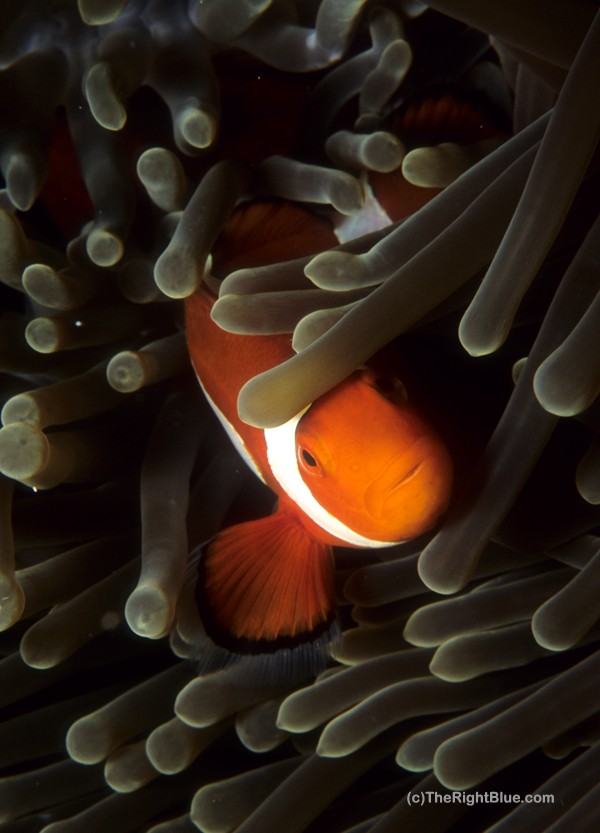
Orange Skunk Clownfish (Amphiprion sandaracinos)
by B. N. Sullivan

This cute little fish really didn't want to have its picture taken.  It was hovering above the tentacles of a carpet anemone when we first spotted it, but as we approached, the fish dived under the anemone's mantle to hide.

I settled in at close range, selected the settings on my camera, and just waited. And waited. And waited some more. Finally the little clownfish peeked out (as we knew it would) and I got my shot.

The fish is an Orange Skunk Clownfish (Amphiprion sandaracinos). I'm not sure of the anemone species, but I believe it belongs to the genus Stichodactyla. I took the photo at  Pulau Mantehage, one of the islands in Bunaken National Park, a marine park in Indonesia.


A Fish with Camouflaged Eyes


Crocodile Fish (Papilloculiceps longiceps), Red Sea
by B. N. Sullivan

Many animals in the sea have evolved colors and forms that allow them to blend in with their surroundings. Some animals use their camouflage to hide from predators — and some predators use camouflage to fool their prey.

The critter in the photo above is a Crocodile Fish (Papilloculiceps longiceps), a bottom-dwelling ambush predator from the Red Sea.  The mottled coloring of this fish matches the sandy areas were it likes to lie in wait for its prey (usually other fishes).  Its body shape, including its head, is quite flat. This "low-rise" profile also makes it less noticeable to fishy passers-by.

Sometimes an animal’s eyes are the one feature that will interrupt the camouflage effect and give it away, but these images illustrate how even a critter’s eyes can be somewhat camouflaged. Take a good look at the eyes of the Crocodile Fish and notice the lappets — the small irregular fleshy flaps that partially obscure the eyeballs — a part of its disguise.

Below is a macro image of the eye of a Crocodile Fish who was nice enough to stay very still even when I came in very, very close to take the photo!  The photo is of a different individual than the one in the image at the top of the page, but it is the same species.

Macro photo of eye lappets on a Crocodile Fish

Note: A portion of this article was published previously in Photosynthesis on ScienceBlogs.com.

Living on the Wreck of the Zenobia: A Mediterranean Moray

Mediterranean Moray (Muraena helena)
by B. N. Sullivan

This is a Mediterranean Moray (Muraena helena).   We discovered this individual while diving on the Zenobia, a large shipwreck in Larnaca Bay, Cyprus. The eel was living in an algae-encrusted drain near what had been one of the big ship's lifeboat stations.

The Mediterranean Moray is known to be territorial (like many other species in its family, Muraenidae).  Thus, we were not surprised when the local dive guide who was escorting us told us that this particular Moray had been residing there for quite awhile, and usually could be seen poking its head out of the same hole on any given day.

This is a carnivorous species.  A nocturnal hunter, the Mediterranean Moray preys on fishes and crustaceans.  This eel also will scavenge dead animal carcasses.

Note:  The photo on this page was taken in 1992, during one of seven dives we made on the wreck of the Zenobia. In 2008,  I wrote about those dives in a series of articles on The Right Blue.  If you are interested, you can have a look at these posts about our dives on the Zenobia:


Finally, here is a link to a recent documentary video about the Wreck of the Zenobia.  The underwater videography is good, and the wreck itself looks much the same as when we saw it years ago.  It looked to us as though many more fish now call the wreck home -- but, alas, we saw no sign of our Mediterranean Moray.

UPDATE:  Okay, we just looked at the film again, and guess what we saw: A moray! [at about 23:24 minutes].  There's no way to know if it's the same moray, or another of the same species, but in any case, the wreck of the Zenobia does still have a resident Mediterranean Moray.

The Spiny Puffer's Message: You can't touch this!


Spiny Balloonfish (Diodon holocanthus)
by B. N. Sullivan

You can't touch this... and you definitely can't swallow it!

That is the message that fishes in the Spiny Puffer family attempt to transmit to potential predators.  While other creatures defend themselves from predators by fleeing, or hiding, or with camouflage, members of this family (Diodontidae) inflate themselves.  In addition, evolution has armed these guys with another feature: rigid spines all over their bodies that are erected when the fish inflates.

The Spiny Puffer's spines actually are like specialized scales. When the puffer is not inflated, most of the spines lie more or less flat against the skin, but when the skin stretches during inflation, the spines go upright.

Ain't nobody gonna swallow these babies!

Puffers are not very streamlined even when they are not inflated, so they are not fast swimmers.  Once they inflate they really are ungainly.  Their little pectoral fins will flutter, but they don't attain much in the way of forward motion.  To survive, they rely entirely on making themselves look unappealing as prey.

When a Spiny Puffer is molested or feels threatened, it opens its mouth and draws sea water into its stomach.  The stomach is capable of expanding greatly -- so greatly that the stomach and its watery contents can virtually fill the whole fish, squishing the rest of its organs up against its backbone.  Its skin is stretchy, too, which also helps it to expand like a balloon.

Both fish pictured in this post are partially inflated.   Each was pottering along in a shallow reef area when we spotted them.   In each case, Jerry shined his light on the fish so that I could approach and aim the camera for a close-up of the Puffer's cute face and interesting eyes.  But these are touchy critters, and that was enough to induce them to begin to inflate, so in each instance I snapped two frames and retreated before they freaked out.

Some divers intentionally harass or even try to grab puffers, just to see them inflate.  This is quite a mean thing to do.  Remember, inflation is a defense.  If the fish begins to inflate, that means it is alarmed.  If it puffs out to its maximum, it is really scared!  This behavior may be amusing to divers, but it really stresses the poor fish.

If you see a puffer and it begins to inflate, move away from it to let it know you are not a threat.  Don't terrorize the puffers!


Spotted porcupinefish (Diodon hystrix)
Spotted  Porcupinefish (Diodon hystrix)
Both of the Spiny Puffers on this page are Caribbean species.  I photographed them on two separate night dives in the Cayman Islands.  To give you an idea of their size, each of these individuals was approximately 12-14 inches (30-35 cm) in length.

The Yellowbar Angelfish (Pomacanthus maculosus)


Yellowbar Angelfish (Pomacanthus maculosus)
Yellowbar Angelfish (Pomacanthus maculosus), Red Sea
by B. N. Sullivan 

If you dive near tropical reefs in the Indian Ocean or the Red Sea, you may encounter the Yellowbar Angelfish (Pomacanthus maculosus).  Often you will see them nibbling on a sponge,  or pecking at corals and algae-covered rocks.  In our experience, they don't seem to be fearful of divers, often swimming right up to have a look at us.  They are known to be territorial, so perhaps they approach divers to judge if they are friend or foe.

The adult of this species, pictured above, grows to a rather large size (for an angelfish!) -- up to about 20 in (50 cm).  The bright yellow patch on their flanks makes them easy to recognize.  Legend has it that the splash of yellow depicts a map of Africa.  That may be a bit of a stretch, but it accounts for the fact that an alternate common name for this species is Map Angelfish.  In any case, the exact shape of the blotch is unique to each fish, rather like a fingerprint.

The individual pictured above was photographed in the Red Sea, near Sharm el-Sheikh, Egypt.

Deep Colors: Masked Butterflyfish Pair in the Red Sea

Masked Butterflyfish (Chaetodon semilarvatus)
Masked Butterflyfish (Chaetodon semilarvatus) in the Red Sea

by B. N. Sullivan

The Masked Butterflyfish (Chaetodon semilarvatus) is one of just a few species in the family Chaetodontidae that mates for the long term, thus they are most often seen in pairs.  They live in the Red Sea and the Gulf of Aden.

These are brilliantly colored fishes with bright yellow, vertically lined bodies.  They have a distinctive grayish blue eye mask,  the feature for which they are named.  "Semilarvatus" in Latin means "Half-mask."  The species has several other common names, including the Blue-cheek Butterflyfish and the Golden Butterflyfish.

I photographed this pair against a backdrop of colorful Nephtheid soft corals in the Red Sea.  Each fish was approximately 18 cm (7 in) long.


The Peppermint Angelfish (Centropyge boylei)

A deepwater Peppermint Angelfish (Centropyge boylei) is on display at the Waikiki Aquarium in Honolulu, Hawaii.  The rarely seen fish was collected by Richard Pyle during an expedition funded by the Smithsonian Institution.  The Waikiki Aquarium's Peppermint Angelfish is said to be the only one of its species in captivity that is also available for public viewing.

Have a look:


If the video does not play or display properly above, click here to view it on YouTube.

Gotta Be Red Sea!

Shoal of Anthias (Pseudanthias squamipinnis) swarming over soft corals in the Red Sea

by B. N. Sullivan

Underwater scenery varies a lot around the world.  Each region has characteristic features and creatures that immediately identify it and set it apart from other areas in the mind of the well-traveled diver.  Just as kelp forests say "California coast" and reef scenes with purple sea fans and yellow-tailed snappers must surely be Caribbean, a photo like the one above immediately brings to mind the Red Sea.

Other locations in the Indo-Pacific region have Anthias, those delightful little goldfish look-alikes, but nowhere else we've been seems to have them in such profusion.  Shoals of Anthias are as ubiquitous in the Red Sea as the soft corals.

In case you'd like to have a better idea of what the individuals of this species look like, here are links to specimen photos from Dr. Jack Randall's collection at the Bishop Museum in Honolulu:

Cute Juvenile Whitetip Reef Shark

Juvenile Whitetip Reef Shark (Triaenodon obesus)
Juvenile Whitetip Reef Shark in the Red Sea

by B. N. Sullivan

Yes, sometimes sharks can be cute.   Just take a look at this shy juvenile Whitetip Reef Shark (Triaenodon obesus), less than two feet long,  trying its best  to hide beneath a table coral.  Tell me you don't feel like patting it on the head!

I photographed this youngster in the Red Sea at Abu Kifan reef, near Safaga, Egypt.  I only managed this one shot of the little shark before it zoomed out of its hiding place and hurried away.  I guess it was spooked by the camera flash.  We swam down the reef to look for it, but we never saw it again.


Ocellaris Clownfish -- The Model for Nemo


Clownfish (Amphiprion ocellaris)
Clownfish (Amphiprion ocellaris) - Pulau Sipadan, Malaysia

by B. N. Sullivan

The clownfish species in the photo on this page is Amphiprion ocellaris.  This species was the model for the Disney/Pixar animated character Nemo, although there are some 30 species of clownfish living in the tropical seas of the Indo-Pacific region.

Clownfish are known also as Amemonefish, after their habit of making their homes among the tentacles of sea anemones.  Each species of clownfish lives preferentially in certain anemone species.   The Ocellaris clownfish in the photo above is snuggled into an anemone called Heteractis magnifica. This anemone appears to be the preferred abode of this fish species, although some Ocellaris clownfish can be found living in anemones of the genus Stichodactyla.  


One Big Butterflyfish!

by B. N. Sullivan

Lined Butterflyfish (Chaetodon lineolatus)

This is the Lined Butterflyfish (Chaetodon lineolatus), perhaps the largest butterflyfish species in the world.  Adults measure about 30 cm (12 in) in length -- nearly twice the size of the majority of butterflyfish species.  The Saddle Butterflyfish (C. ephippium) is the only other butterflyfish species that approaches (and may sometimes match) the size of C. lineolatus.

This is an Indo-Pacific species widely distributed throughout the region.  We have seen them in the Red Sea and in Hawaii, but they are known to occur as well along the shores of East Africa, Southern Japan, and Australia's Great Barrier Reef.

We have observed them almost always in pairs.  They hang out around coral reefs, which is not surprising since they feed primarily on coral polyps.  It is not unusual to see a pair of these fishies bobbing along side by side as they peck away at a coral head.  According to the World Register of Marine Species (WoRMS) page on C. lineolatus, they also feed on anemones, small invertebrates, and algae.

Lined Butterflyfish are believed to be a long-lived species.  Although no one knows for sure how long their natural lifespan is, it is likely several decades.  In places like Hawaii where local divers may visit the same site again and again over years or even decades, the divers learn to recognize individual animals that live there.  We got to know a certain pair of C. lineolatus living in Honaunau Bay, on the South Kona coast of Hawaii Island and have seen them there again and again over a period of at least 15 years.

Honaunau Bay is a popular snorkeling and shore-diving  spot for tourists as well as locals, and many have fed the reef fish there over the years.  While guides and tour operators currently do a good job of discouraging this practice, the fish seem to have long memories.  The pair of Lined Butterflyfish in the image below still approach divers, ever hopeful for a hand-out.


Diver with Lined Butterflyfish
A diver interacts with some Lined Butterflyfish in Honaunau Bay, Hawaii


The Ornate Butterflyfish (Chaetodon ornatissimus)

by B. N. Sullivan

Fishes in the Butterflyfish family (Chaetodontidae) are among the prettiest inhabitants of tropical reefs around the world.  This species, the Ornate Butterflyfish (Chaetodon ornatissimus) is particularly nice looking, we think.

The Ornate Butterflyfish is easy to recognize, with six diagonal yellow-orange stripes on each side of its creamy body, black and yellow bars on the face (including one that covers the eye), a gray patch on its forehead, and black 'trim' around its margins.  They are said to grow to a length of 20 cm (about eight inches), although most of the adult individuals we have seen are somewhat smaller -- usually about 15 cm (six inches).

C. ornatissimus feeds exclusively on live coral polyps, so you would expect to find them in coral-rich areas. They seem to favor coral polyps of the Pocillopora and Montipora genera.  (Here in Hawaii, we frequently see them pecking on Pocillopora meandrina.)

Juveniles of this species look like cute miniatures of the adults.  The juveniles can be quite shy, hiding in corals for protection.  The juveniles live as singletons, but once they reach breeding age, they find mates and form pairs.  In fact, it is unusual to see an adult of this species not accompanied by its mate.  Also, pairs establish a home range, so once you discover a pair of C. ornatissimus, you will likely be able to find them again in the same area time after time.

'Ornates' are an Indo-Pacific species, most commonly found in the central and western Pacific, from Hawaii to Australia's Great Barrier Reef.  Sightings have been reported as well around Christmas Island in the eastern Indian Ocean, and we have seen photos of the species taken in Indonesian and Malaysian waters.  They are quite common here in Hawaii. I photographed the one pictured on this page in Honaunau Bay, on the south Kona coast of Hawaii's Big Island.

Don't feed the critters


by B. N. Sullivan

There are some dive sites where you know immediately that the fishes and other critters are used to being fed by divers and snorkelers.  How can you tell?  You can hold out your hand, like Jerry is doing in the photo above, and see if the fishes come forward.  Sometimes you don't even need to extend your hand.  At some sites, the fishes begin to converge on divers as soon as they descend from a boat.

So, is feeding the critters a bad thing or an okay thing to do?  Generally speaking, we advise against it.

For one thing, it can be disruptive to the critters in a number of ways.  Feeding an animal something that it would not naturally eat can disrupt its digestion and nutritional status.  Even if you choose to feed something the animal might normally eat, you alter its natural feeding behavior by supplying the food item.

For another thing, feeding critters encourages them to congregate in places where they might not normally stay -- like at the base of a boat mooring.  While the critters may learn that if they hang out in a particular place, they will be fed, their predators also learn this.  You may be setting up the unsuspecting recipient of your offerings for becoming a meal himself!

And then there's the diver safety issue.  If you've ever been mobbed by a swarm of fishes expecting a handout, you know what I mean. We have been followed around on many occasions by fishes that had become accustomed to being fed -- including eels and stingrays.  As annoying as being mobbed by Snappers or Butterflyfishes may be, it can be worse -- even dangerous -- if the hungry critters are large and/or toothsome and aggressively pursue divers expecting a treat.

Long-time readers of The Right Blue may recall a story we told awhile back about a particularly aggressive Napoleon Wrasse in the Red Sea.  The huge fish was accustomed to being fed boiled eggs.  The wrasse  apparently mistook the white second stage of our friend's regulator for an egg, and chomped it hard enough to detach it from the hose.

We know a dive guide who used to feed a certain large Moray eel, and then pet it.  One day he reached out to pet the eel and it snapped at him, clamping down on his finger.  At the hospital emergency room the doc said the only reason the dive guide did not lose that finger was because he was wearing a heavy class ring, which probably deflected the eel bite just enough to save the digit (although it was pretty badly mangled).

Remember, folks.  The creatures you see in the ocean are wild animals, not pets.  Don't give them indigestion and don't mess with the natural food chain.  Don't feed them.

About the photo:  I took this photo of Jerry (and a handful of Yellowtail Snappers) at the wreck of the Oro Verde, located off Grand Cayman's Seven Mile Beach.

Whale Shark excitement on the Kona Coast

by B. N. Sullivan

In late February we posted an article about Whale Sharks (Rhincodon typus), with a video to illustrate. That video was shot at Christmas Island in the Indian Ocean. We now direct your attention to another Whale Shark video, shot a year ago on the Kona coast of Hawaii.

YouTube user dolphinmind, who posted this video of some very happy snorkelers' encounter with the Whale Shark, said:
A great day of Kona Coast snorkeling on Hula Kai turned unforgettable by an extremely rare 40 foot long whale shark encounter... Folks...no special effects or editing on this video...it's REAL. ...
Yep, and it's REAL BIG!


If the video does not display or play properly above, click here to view it on YouTube.

Whale Sharks: The biggest fishes in the ocean

by B. N. Sullivan

There are lots of fishes in the sea, but there are none bigger than the Whale Shark (Rhincodon typus). These huge sharks live in tropical waters around the globe, and we have had encounters with them in many locations. Seeing these magnificent animals always is a thrill. Their size -- up to about 40 feet (12 meters) in length --  is impressive, and their grace is almost magical.

Unlike most sharks, Whale Sharks are filter feeders. They feed on krill, algae, plankton, and other small organisms suspended in the water. They take in large gulps of sea water, and sieve out the food as it passes over the denticles that cover their pharynx and gill plates. The water is expelled through the gills, while the filtered-out food remains and is swallowed.

No one knows for sure how long Whale Sharks live, but estimates of the creatures' natural lifespan range from 70 to about 100 years.  Whale Sharks do not reach sexual maturity until they are about 30 years old.  They are ovoviparous: that is, their eggs hatch inside the mother, develop without a placenta, and then emerge as live young.

Whale Sharks are curious and often approach divers and snorkelers to have a look, and will sometimes swim alongside them, but these  sharks are not known to be aggressive.  Encounters with these enormous but docile creatures are a joy for divers.

Here is a video, shot at Christmas Island in the Indian Ocean, that perfectly illustrates the excitement of divers who encounter Whale Sharks in the open water:


If the video does not play or display properly above, click here to view it on YouTube.

If you are interested to learn more about Whale Sharks, we recommend you have a look at this Whale Shark (Rhincodon typus) Issues Paper, from the Australian Dept. of the Environment, Water, Heeritage and the Arts; and the Whale Shark page on the National Geographic Web site.