
When we think of marine life, we most often think of fish, of course. Next we probably think of invertebrates such as crabs and lobsters, corals, and marine mammals like dolphins and whales. We sometimes overlook the fact that there are many species of birds that qualify as marine life, too.
One kind of marine bird that we are getting to know during our New Zealand trip is the penguin. Until we came to New Zealand, we had never seen a live penguin except at a zoo or marine park. This trip has afforded us our first opportunity to see penguins in the wild.
Several species of penguin make their home on the coasts of New Zealand's South Island, but by some stroke of fate or luck, the first one we are learning about -- and writing about in
The Right Blue -- is the Blue Penguin (
Eudyptula minor).

The feathers on the Blue Penguin's back and head really are blue, but they look more blackish when they are wet. They are cute little fellows -- and they are indeed little. In fact the Blues are the smallest penguin species in the world. Adults usually weigh about a kilogram (a little more than two pounds), and they stand about 30 cm (1 foot) tall.
Despite their small size, Blue Penguins can swim fast underwater -- about 8 km (5 miles) per hour. They spend most of the daylight hours swimming at sea, diving again and again to catch their prey -- small fish and squid. According to the folks at the
Oamaru Blue Penguin Colony, these birds are known to make an average of about 800 dives each day. Each dive lasts about 20-30 seconds, although Blue Penguins are able to hold their breath for up to two minutes.
When they swim on the surface, they assume a prone position that makes them look like chubby ducks. On land they stand upright, and walk in a waddle, rocking back and forth with each step.
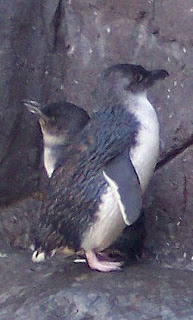
Penguins' wings are used to propel them when they swim underwater. When they walk on land, they tend to hold out their wings to help balance. They are not able to fly.
Their natural predators at sea are sharks, killer whales, sea lions, and leopard seals. On land they are sometimes killed by ferrets, dogs, and other predatory mammals. Like other marine animals, Blue Penguins also face man-made dangers. They sometimes become entangled in fishing gear and other marine debris, and their nesting grounds are damaged and encroached upon by people and pets.
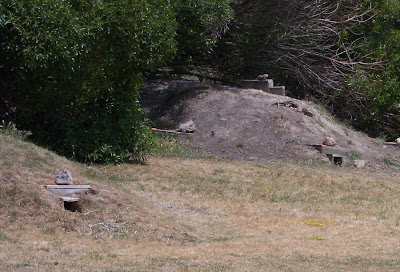
Approximately 200 Blue Penguins make their home in an area near the port of Oamaru -- situated on the South Island's east coast, about an hour's drive north of the city of Dunedin. Volunteers have provided the Oamaru Blue Penguin colony with nesting boxes in artificial burrows (see photo below). Access to the area is restricted during the hours when most of the birds come ashore to rest and feed their chicks.
They come ashore each evening at dusk, and spend the night on land in burrows where they nest. At dawn they emerge from their burrows and return to the sea to find their food, often ranging as much as 25 km (about 15 miles) offshore in the course of a day's swim.
To see more detail, click on any of the photos to enlarge.

BNSullivan.jpg "A young girl watches a Little Blue Penguin at New Zealand's Antarctic Center") The young girl in the photo at right is watching a Little Blue Penguin (Eudyptula minor). The little bird, which had been injured, now lives in a managed colony of rescued penguins at the Antarctic Center, Christchurch, New Zealand. We visited the Antarctic Center in December of 2007.
The young girl in the photo at right is watching a Little Blue Penguin (Eudyptula minor). The little bird, which had been injured, now lives in a managed colony of rescued penguins at the Antarctic Center, Christchurch, New Zealand. We visited the Antarctic Center in December of 2007.


BNSullivan.jpg "White-faced Heron (Ardea noavaehollandiae)")


BNSullivan.jpg)
BNSullivan.jpg)
BNSullivan.jpg)
BNSullivan.jpg)
BNSullivan.jpg)
BNSullivan465x300.jpg)
BNSullivan.jpg)
BNSullivan930x600.jpg)

