Showing posts with label wreck diving. Show all posts

Living on the Wreck of the Zenobia: A Mediterranean Moray

Mediterranean Moray (Muraena helena)
by B. N. Sullivan

This is a Mediterranean Moray (Muraena helena).   We discovered this individual while diving on the Zenobia, a large shipwreck in Larnaca Bay, Cyprus. The eel was living in an algae-encrusted drain near what had been one of the big ship's lifeboat stations.

The Mediterranean Moray is known to be territorial (like many other species in its family, Muraenidae).  Thus, we were not surprised when the local dive guide who was escorting us told us that this particular Moray had been residing there for quite awhile, and usually could be seen poking its head out of the same hole on any given day.

This is a carnivorous species.  A nocturnal hunter, the Mediterranean Moray preys on fishes and crustaceans.  This eel also will scavenge dead animal carcasses.

Note:  The photo on this page was taken in 1992, during one of seven dives we made on the wreck of the Zenobia. In 2008,  I wrote about those dives in a series of articles on The Right Blue.  If you are interested, you can have a look at these posts about our dives on the Zenobia:


Finally, here is a link to a recent documentary video about the Wreck of the Zenobia.  The underwater videography is good, and the wreck itself looks much the same as when we saw it years ago.  It looked to us as though many more fish now call the wreck home -- but, alas, we saw no sign of our Mediterranean Moray.

UPDATE:  Okay, we just looked at the film again, and guess what we saw: A moray! [at about 23:24 minutes].  There's no way to know if it's the same moray, or another of the same species, but in any case, the wreck of the Zenobia does still have a resident Mediterranean Moray.

Wreck diving: Beware of entanglement

wreck diving


by B. N. Sullivan

What:  This photo of Jerry ascending from a wreck dive is a reminder that the potential for entanglement is one of the hazards of diving on natural wrecks.  Wrecks that have been intentionally sunk as artificial reefs and diver playgrounds usually are prepared ahead of time to minimize hazards that could lead to diver entanglement or entrapment.   Doorways and portholes are removed or welded open, and cables, lines, and other sources of entanglement are taken off the vessel.  This is not the case with natural wrecks, i.e., vessels that have sunk as a result of an accident, or war.  Proper training in wreck diving will educate the diver about how to recognize and cope with the risks entailed in diving on natural wrecks.

Where:  I took this photo of Jerry at the site of the wreck of the Zenobia, a modern ship that sank in 1980 off the coast of Larnaca, Cyprus.  The Zenobia was a huge vessel, more than 172 meters (560 feet) in length, with a beam of about 23 meters (75 feet).  Click here to see a photo of the Zenobia, just before she sank.

We made a number of dives on the wreck of the Zenobia in the 1990s.  In case you missed our series of articles about those dives (with photos), here they are:

Diving the Wreck of the Dunraven in the Red Sea

by B. N. Sullivan

DunravenThis is the third post in a series about the wreck of the Dunraven, a 19th century cargo ship that sank in the Red Sea on April 25, 1876. The ship went down after hitting rocks off the coast of the Sinai peninsula. The rocks pierced the forward section of the vessel's hull, causing it to fill with water and sink. The first photo on this page, at right, shows divers examining the large hole in hull that ultimately sank the Dunraven. (Earlier this week I wrote about the history of the ship and how it met its end, and some wide-angle photos of the wreck. )

Today's topic is diving on the wreck of the Duraven. The photos in this post have been reduced in size. If you click on the photos to enlarge them, you will be able to see more detail.

We have dived the Dunraven on a number of occasions. As wreck dives go, it is a fairly easy one. It does not really require specialized wreck diving skills, however divers who visit the Dunraven should get a detailed briefing ahead of time from a qualified dive guide about what to expect, especially if they intend to penetrate the vessel. Prior to the dive you should know about the layout of the vessel, the route you will follow, and the conditions at the site. If this information is not volunteered by your dive guide, ask!

By the way, the bottom at the site of the wreck is at roughly 30 m (100 ft), so divers who visit the Dunraven should be prepared for that depth.

As the Dunraven sank, its water-filled hull capsized, and it settled onto the bottom upside down. Today the ship's inverted hull is split in two at about the midpoint of its length. The opening there makes for easy entry to the inside of the wreck by divers: A standard dive on this wreck entails entering there, swimming forward through the wreck, and exiting through the hole in the bow that was created by the impact that sunk the vessel.

Here, divers are approaching the large break in the middle of the hull, where they will enter the wreck:

Dunraven

The inside of the wreck is dark, so it is necessary to bring along bright hand-held lights in order to find your way through the vessel, and also to see features of the ship's interior, its boilers, and the marine creatures that now call the Dunraven home.

Some of the divers in our party did not want to penetrate the wreck. I took this photo from inside the wreck while they were peeking at us from the outside, through a hole:

Dunraven

Large, dense schools of Glassfish live permanently inside the Dunraven. Divers must swim through these schools of fish as they pass through the wreck. Also seen frequently inside the wreck: Squirrelfish, Bigeyes, and Lionfish.

In the photo below, divers are swimming through a swarm of Glassfish and exiting the wreck via the hole in the bow:

Dunraven

Having been at the bottom of the sea for well over 100 years, the exterior surfaces of the Dunraven are totally encrusted with corals. Many small creatures live amongst those corals, and it is worth taking the time to poke around to find creatures such as Nudibranchs, and Pipefish. You might also spot a bottom-dwelling fish such as a Stonefish or Scorpionfish alongside the hull where it touches the sand.

Here is a photo of Jerry swimming along the bottom, outside of the wreck of the Dunraven. You can see how the hull is completely covered with marine life:

Dunraven

One word of caution to divers who intend to visit the Dunraven: the area is prone to strong currents. Here is Jerry, swimming near the Dunraven. You can see by the angle of his bubble stream that he is swimming across a substantial current:

current

When a current is running, a good way to dive this site is to have a boat drop you right over the wreck site, and then pick you up 'downstream' at the end of the dive. It is important, in such cases, to descend to the wreck quickly, before you are swept away. A good plan is to explore the wreck, and then ride the current while gradually ascending along the face of the nearby reef wall to a downstream pick-up point.

The beautiful reef wall that is adjacent to the wreck of the Dunraven is very lush. The wall is well populated with fish, crustaceans and corals of many types. You also may encounter larger fish in the area, such as Napoleon Wrasse, Barracudas, Sharks and Stingrays.

Related:

The Dunraven, a 19th Century Shipwreck

Wordless Wednesday
Watery Wednesday

What: Wreck of the Dunraven, a 19th Century British cargo ship.
Learn about this shipwreck here.
(Come back on Thursday for a post about diving on the wreck of the Dunraven.)

Where: I took these photo in the Red Sea,
near the southernmost tip of Egypt's Sinai Peninsula.

Click on the photos to enlarge.

Dunraven

Dunraven

History of the Dunraven, a Shipwreck in the Red Sea

by B. N. Sullivan

Dunraven wreckA popular dive site in the northern Red Sea is the wreck of a ship called the Dunraven. This shipwreck is located near the southernmost tip of Egypt's Sinai peninsula, close to a landmark called Beacon Rock (AKA Sha'ab Mahmoud), near the mouth of the Gulf of Suez.

Today we will review the history of the Dunraven. In the next two posts, we will present more photos of the Dunraven, and tell about diving on the shipwreck.

The Dunraven was a British cargo vessel that was built, operated, and sunk in the late 19th century. Over the years since the vessel's remains were discovered by divers, many stories have been circulated about the history of the Dunraven. At one time it was thought to have been either a spy ship or a treasure ship associated with Lawrence of Arabia. These stories later proved to be false. Instead, it appears the Dunraven had a far less romantic history.

The Dunraven was built in England, at Newcastle, and launched in 1873. Like many of the most modern vessels of that era, she was powered by both steam and sail. The ship was nearly 80 m (260 ft) long, with a beam of just under 10 m (33 feet).

The Dunraven plied the route between England and India. On what turned out to be her final voyage, the ship had carried timber and steel from Liverpool to Bombay, and was making the return trip laden with general cargo when tragedy struck. According to historical data about the vessel compiled by Ned Middleton, the Dunraven left Bombay on April 6, 1876 loaded with cargo bound for Liverpool. The ship, with her crew of 25, crossed the Indian Ocean in good time and entered the Red Sea, stopping at Aden for coal. She continued northward through the length of the Red Sea, apparently headed for the Suez Canal.

DunravenIn the wee hours of April 25, 1876, the Dunraven, running at full speed under steam power, was approaching the mouth of the Gulf of Suez. As the story goes, a sailor on watch spotted a large dark object, and thought it was a buoy. The Second Mate also saw the object and thought it was a boat.

In any case, the Captain ordered the engines stopped, but it was too late. The ship hit what turned out to be rocks, and the hull was breached at the fore compartment (see photo at left).

Middleton writes:
The steam pumps were immediately set to work and a fruitless attempt was made to heave her off by means of a kedge anchor. By 7am, the water reached the engine room and put out the fires. By midday the starboard side of the upper deck was under water and the Master and crew took to the lifeboats. They remained with their doomed vessel and at 4pm an Arab Dhow came alongside and took the shipwrecked mariners on board. It was only at this time that the Master of the Dunraven was made aware if his actual position - off the southern tip of the Sinai Peninsular.

At 5 pm, the Dunraven slipped off the reef and sank in 15 fathoms (27 m) of water. For three days the Dhow lay at anchor over the Dunraven until Captain Care and his crew were transferred to the passing Italian steamer "Arabia" which conveyed them to Suez. The Peninsular and Orient steamer "Malwa" later transported them all back to England.
Tomorrow, we will post some more photos of the wreck of the Dunraven for Wordless/Watery Wednesday. Then, later in the week, we will tell about diving on the this famous shipwreck in the Red Sea. Stay tuned!

Wreck Diving in The Right Blue

wreck divingSome of the most popular stories on The Right Blue have been those about our wreck diving adventures. Those stories and photos not only got good response when we first published them, they have continued to draw a lot of search traffic ever since. (In fact, our series on the wreck of the Salem Express, first published in September of 2007, still gets traffic nearly every single day!)

As a part of our review of The Right Blue's first year, we thought we'd assemble links to all of the wreck diving photos and stories on one page, as a permanent archive. Later, when we publish new wreck diving stories, we'll add them to the list on this page.

Here is a directory of wreck diving stories and photos in The Right Blue, arranged alphabetically by the name of the wreck:

Final Dives on the Wreck of the Zenobia

by B. N. Sullivan

This is the final article in a series about our seven dives on the wreck of the Zenobia, a large ship that sank off the coast of Cyprus in 1980. If you missed the earlier episodes, we invite you to scroll down to the bottom of this article for links to the whole series.

Diver swimming near a shipwreckIn the most recent episode, we talked about our first dive inside the sunken ship. For that dive, we entered the Zenobia's upper parking deck through a doorway near the bow end of the ship, swam through, and exited through a larger opening closer to the stern. For successive dives, we took the opposite route, entering the parking deck through the larger opening and exiting through the doorway situated underneath the ship's bridge, near the bow.

The first dive inside the ship was all about getting a feel for the vast interior space that had been the big ferry's upper parking deck. Now that we were more oriented, we could concentrate on what there was to see of the Zenobia's cargo, and the creatures that had taken up residence inside the sunken ship.

I mentioned earlier that the Zenobia was carrying more than 100 fully loaded lorries (trailer trucks). Those trucks, which had been lined up in the parking deck when the ship was still on the surface, now lay in a jumbled pile against the port wall of the parking deck, having tumbled there as the ship sank and settled on the sandy bottom on its port side. Many of the trailers had broken up and released their pallets of cargo to scatter about. We saw shoes, clothing, machinery, and cans of house paint that had been destined for distant ports, but never made it.

Diver inside a shipwreckWe looked all around inside the big ship, shining our lights here and there as we went along. In one of those sweeps, we saw what looked like a pile of bones. As far as we knew, no one had died when the Zenobia sank, so we were very surprised to see bones -- big bones -- piled in disarray near the remains of a half-disintegrated truck body.

Looking more closely, we saw what looked like thigh bones and ribs -- BIG ribs. It was a grisly looking sight and we were taken aback at first, but on closer inspection it became clear that we were looking at animal bones. The bones were all that remained of the cargo of a refrigerated truck that had been on board the Zenobia. The truck had apparently been carrying sides of beef and other large pieces of meat. Over time the bones had been picked clean by fish and crabs, I guess. The truck in which they were being transported had decayed and broken open. In sum, it was a rather distasteful sight, and we didn't linger.

In addition to the lorries and what remained of their cargo, we did see a lot of other things inside the parking deck, including an amazing assortment of living creatures. We saw several kinds of crabs, and two species of small nudibranchs (snails without shells). We saw many crinoids -- also known as feather stars -- a class of creatures that are in the same phylum as sea stars (starfish), but with arms that resemble feathers and a separate set of little feet that they use for locomotion, and also for hanging on to wherever they are perched. The crinoids inside the Zenobia were very delicate and flimsy looking, compared to most we had seen elsewhere.

Shipwreck doorwayWe saw quite a few fish, of course, darting in and out of the debris inside the Zenobia's parking garage. They were mostly small fish, like little wrasses and cardinalfish, and two small groupers. The photo at left shows the now-horizontal doorway that was our entrance for our first dive into the parking deck, and our exit for the final two dives. It looked a bit smaller when we were further inside the wreck, but it made a nice picture frame for fish that were busily going about their business outside the wreck. At one point we looked toward that door and saw framed there a small school of silvery jacks zooming past in a parade, a lovely sight we'll never forget.

While most of the fish we saw inside the wreck were small, we did see one large grouper. He was hiding in a nook a few meters inside of the door where we would exit. We disturbed him inadvertently, and he shot out between us and hurried through the door, away from us. Ten minutes or so later when we emerged from the wreck, there was the big grouper, hanging out near an algae-covered ladder on the exterior of the ship, not far from the doorway. As soon as we were completely out of the parking garage into the open again, the grouper hurried back inside, looking very annoyed. I could have sworn I heard him 'harumph' as he passed by us, probably calling us names under his fishy breath for having disturbed him in the first place.

On our next to last dive on the Zenobia, we saved a little time to swim through the ship's bridge. We also had a look inside what had been the ship's restaurant, where the drivers of all those lorries took their meals during the voyage. We saw three more small groupers in there, too.

Divers ascendingOne of our favorite finds on the Zenobia was a good-sized Mediterranean Moray (Muraena helena) that had taken up residence in a drain near one of the Zenobia's lifeboat stations. Ian, our guide, told us that eel had been living there for quite some time, and could be found in that spot reliably, just about every day. Click here to see a photo of the Mediterranean Moray that made its home on the Zenobia.

We felt fortunate that we had a whole week to spend on that trip, so that we could take our time exploring the Zenobia on those seven dives. This was not the first wreck we had dived on, nor was it the last, but to this day, we have never dived on a larger shipwreck. Diving on the Zenobia was a truly memorable experience.

We'll end our tale with a photo of the divers in our party ascending from the wreck for the last time, making their final decompression stop before climbing into Ian's boat to go back to the dock in Larnaca. Ian McMurray, who pioneered diving on the wreck of the Zenobia, and who was our guide for our dives there, is still taking divers to see this huge underwater wonder. If you are interested, visit the Octopus Diving Centre in Larnaca, Cyprus. Tell Ian that you read about the Zenobia on The Right Blue, and give him our regards.

Here are the links to all of the articles in this series about diving on the wreck of the Zenobia, near Larnaca Cyprus:More photos from the Zenobia:

Diving Inside the Zenobia's Parking Deck

by B. N. Sullivan

This is part five of the story of our seven dives on the wreck of the Zenobia, a ferry full of commercial vehicles that sank off the coast of Larnaca, Cyprus in 1980. Here are the links to the story so far: the Introduction; a Brief History of the ship (including a photo of what it looked like before it sank); the story of our first dives on the Zenobia; and our visit to the ship's stern area and propellers.

Earlier, I mentioned that the Zenobia was a "ro-ro" ferry. "Ro-ro" is short for roll on - roll off, a reference to the fact that the ship was designed to transport fully loaded commercial trucks, which are driven onto the ferry at the departure point, and driven off again at the destination. In the Zenobia's case, more than 100 articulated lorries -- also known as double-trailer trucks -- were on board when the vessel sank. All of those lorries were full of goods that they were to deliver when they reached their destination port. They never made it. Although her crew members were safely rescued, all those lorries and their cargo went to the bottom with the big ferry when it sank.

After a few dives on the exterior of the Zenobia to orient ourselves to the vessel, we were ready to penetrate one of the parking decks to see what was inside. The Zenobia had several parking decks, in layers. We made three dives inside the upper parking deck, which was the most accessible.

For the first of the three penetration dives, we entered at the bow end of the Zenobia's upper parking deck, through a doorway located under the bridge deck. Because the ship was lying on its side, the doorway was horizontal now. As I said in an earlier post, it looked more like an oversize mail slot than a doorway. Ian, our guide, told us to stop once we passed through the doorway into the wreck, so that our eyes could adjust to the darkness.

We entered one by one, and paused for a moment. The interior of the parking deck was enormous and very dark, with almost no ambient light. Imagine a large gymnasium with high ceilings, then turn it on its side, and turn out all the lights. That was the sort of space we were in. Off in the distance, in the direction of the stern, we could see the faint glow of daylight at the opposite end of the parking deck. The stern end of the parking deck had a large opening. That would be our target for exiting the wreck on this first penetration dive.

We shined our spotlights all around before we proceeded. We saw ahead of us a hanging jungle of pipes, cables, and other material. We were near what had been the outer wall of the parking garage -- except now that the ship was on its side, that wall was overhead. After slowly deteriorating underwater for 12 years, all of the insulation and wiring and conduits that had been attached to the wall now were hanging down in a tangle.

Ian had briefed us ahead of time about this disorderly mass of obstructions that had the potential to entangle us. We had to descend quite a bit to avoid most of the hanging debris. We swam ahead cautiously, sweeping our spotlights in every direction in order to avoid getting snagged, and intermittently shining our lights onto our instruments to monitor our depth, elapsed time, and air supply.

We felt very tiny as we passed through the vast parking garage. The beams from our lights shone only a couple of meters in front of us, so there were few visual reference points as we swam. Because it was so dark, it would have been easy to become disoriented. We had to be careful to stay level, and not to drift down too deep for too long.

At first we were so focused on avoiding all these potential hazards that we almost forgot about the lorries inside the parking deck. Then we saw them, piled up in a huge heap against what had been the opposite wall of the parking deck. Some of the trailers had broken up, revealing -- and in some cases releasing -- their cargo. For example, we saw lots of shoes, and items of clothing. Some were floating around freely inside the wreck (creating yet another hazard), while other items littered the heap of trucks.

Ian had warned us ahead of time to watch out for the paint. At least one of the lorries had been carrying a full load of house paint, in large cans. The cans had typical pry-off lids on them, and over time, some of the paint had begun to seep out of the cans. Because the paint was thick and cold, when it seeped out it formed globs that were shaped like large, richly colored, upside down teardrops. It was fascinating to see them bobbing about here and there.

Ian had admonished us not to touch the paint globs. He said he had learned from experience that when the paint globs were touched, they burst like bubbles, and whoever did the touching ended up with paint all over themselves and their dive gear as a permanent souvenir. Then the paint-christened divers also brought their colors back aboard Ian's runabout after the dive. He teased us that if we came back to his boat covered with paint, we would just have to swim the mile or two back to shore. We didn't touch any of the paint globs, just in case he wasn't teasing.

Now that we had a clearer picture in mind of what to expect inside the Zenobia -- and now that Ian was satisfied that we could manage our dives inside the cavernous parking deck -- we were ready to make two more penetration dives, but in the opposite direction. On our next two dives through the parking deck, we would enter through the larger opening at the stern end, and exit through the 'mail slot' doorway near the bow. In the next (and final) episode of this tale, we will tell you about what else we saw inside the Zenobia -- including both living creatures, and some that were, shall we say, formerly alive. Stay tuned...

Bottom Time on the Wreck of the Zenobia

by B. N. Sullivan

This is a continuation of the story of our seven dives on the wreck of the Zenobia, a large ship that sank off the coast of Cyprus in 1980. In case you have missed them, here are the links to the previous chapters: Introduction; a Brief History of the ship (including a photo of what it looked like before it sank); and the story of our first dives on the Zenobia.

I mentioned previously that the Zenobia was some 560 feet long, and that because visibility underwater is more limited than on the surface, it was impossible to see the entire vessel at once. We had to explore the vessel section by section on successive dives.

We usually entered and exited the water at the mooring line that was attached to a structure a little astern of the Zenobia's bridge, but we did one dive a bit differently. This shipwreck was so large that in order to have a good look at the stern area and the propellers, we had to do a one way dive.

We were using single tanks of air, not doubles, and we were trying to keep our decompression times to a minimum. If we began our dive at the mooring line and swam straight along the Zenobia's hull to her stern, we would have had barely enough time and air to look at anything much before we would have had to turn around and swim back.

Ian, our guide, proposed that he drop us off right over the stern instead of at the mooring buoy. That way we could descend directly to the stern area of the ship, maximizing our time there. When we were finished looking around, we could make a beeline swim back to the mooring line and ascend as usual. This turned out to be a great plan.

We dropped into the water from Ian's runabout and descended directly to the stern of the Zenobia's hull. We had plenty of time to have a look at the immense stern doors, which, when opened, turned into ramps that the trucks on board used to exit the ship and drive onto a dock. Like almost everything else on the Zenobia, the stern doors had a thick coating of algae. We shined our lights on the surfaces as we moved along, and we discovered quite a few little critters living in nooks and crannies of the outer surface of the stern doors, mostly little crabs, and nudibranchs (snails without shells).

We descended along the stern doors to a depth of about 105 feet (32 meters) and then swam to our right. Remember, the ship was lying on its port side, so by swimming right, we were going in a direction that would have been down if the ship still had been upright. We rounded the corner at what had been the base of the stern doors, and immediately caught sight of the ship's starboard rudder, which was now horizontal instead of vertical. Just forward of the rudder was the starboard propeller.

The first photo on this page (above, left) shows what we first saw. The flat part on the left side of the photo is the ship's bottom. The rudder is the structure in front of the propeller. (If you click on the photo, it will enlarge and you can see these structures more clearly.) In case you are wondering, there were identical structures on the port side of the ship, but they were even deeper, of course.

A trick underwater photographers use to give an idea of the size of a structure on a wreck, such as a propeller, is to have a diver pose next to it, as a visual reference. We had done this any number of times, and this time was no different in that respect. We had agreed ahead of time that when we got to the propeller, Jerry would pose next to it.

I remember signaling to Jerry to go to the propeller, while I swam out, away from the ship, so that I could get a long shot. I turned around just as Jerry was settling onto the end of the propeller shaft, and when I looked through the camera's viewfinder, I did a double take. What was different this time was that when Jerry stood up beside the propeller, one blade turned out to be as tall as he is -- six feet. We already knew that the Zenobia was the largest shipwreck we had ever dived on, but now that fact seemed to register in a whole new way!

We exchanged a flurry of hand signals, telling each other the obvious: this was a really big propeller. Sometimes divers tend to get a little silly like that when they are excited -- and beginning to feel the effects of the nitrogen in their bloodstreams. (I'm sure that other divers reading this know exactly what I mean!)

We weren't so silly and excited that we forgot to mind our air supply and our dive computers. It was just about time to beat feet, er, fins back to the mooring line for our decompression and final ascent, but Jerry signaled to me that he had an idea for just one more photo.

That 'one more photo' is the final photo on this page: Jerry doing a handstand on the top of the propeller blade. (Applause, please.)

We're not finished with our Zenobia stories just yet. We hope you will come back to read the next episode, about what we saw on the several dives we did inside one of the Zenobia's parking decks, where all those lorries and their cargo now lay scrambled in a heap.

First dives on the wreck of the Zenobia

by B. N. Sullivan

Diver on a wreckThis is part three of our series about diving on the wreck of a ship called the Zenobia, at Larnaca Bay, Cyprus. If you have not done so, you may wish to read the introduction to this series, and the brief history of the vessel and how it sank before reading about the dives we did.

Jerry and I made a total of seven dives on the Zenobia. Our guide for all of those dives was Ian McMurray, owner of the Octopus Diving Centre in Larnaca, who pioneered diving on this wreck. Our friend Joe joined us for three of those dives. That's Joe in the photo at right, checking the settings on his camera as we set out on the first of our dives. [Click on any of the photos to see an enlarged version.]

Each day, we boarded Ian's runabout at a dock in Larnaca, and zoomed a mile or two out to sea to a mooring buoy. Once the runabout was tied up at the buoy, we 'kitted up' and entered the water. We descended to the wreck by following the mooring line, which was attached to a structure on the wreck's starboard side, astern of the bridge, at a depth of about 16 meters (53 feet).

shipwreckDuring our first few dives on the Zenobia, we surveyed the exterior of the vessel to orient ourselves. According to the notes in my dive logbook, the sandy bottom was between 42 and 43 meters deep (roughly 140 feet), but for those first dives we stayed at depths of 30 meters and above (100 feet or less). There was plenty to see.

The ship lies on its port side, so all of the structures on the vessel are at a 90-degree angle to what they had been while the ship was still afloat and upright. What had been the starboard side of the hull now faced upward, looking like a long, wide deck. The ship's radar mast jutted out horizontally from what had been the top of the superstructure, and it now resembled a perch for a large bird.

Entrances to the interior of the ship from the outer decks were now horizontal, too, so they looked like oversize mail slots rather than doorways. Stairways and ladders also were horizontal, so what had been up was left, and what had been down was right, and so on. It takes a bit of getting used to.

It was very sunny on the surface, so there was a good amount of light shining down through the water onto the wreck. However, after 12 years underwater, every surface of the Zenobia was completely coated with algae. Tiny pieces of algae constantly flake away from surfaces and hang suspended in the water column near the wreck, along with other bits, such as plankton, that occur naturally in sea water.

shiprwreckLimited visibility can be a problem for divers trying to take in the scene at a wreck. On land, we are accustomed to being able to see as far as the horizon, unless a building or some other obstruction is in the way. Since sea water is a much heavier medium to look through than air, visibility underwater rarely will be more than 100 to 150 feet, even when the water is crystal clear. More frequently, underwater visibility is quite a bit less than that, due to plankton, sand, silt or other particles suspended in the water. These deflect and scatter light and reduce visibility underwater, just like smoke, smog, and fog reduce visibility on land. (And that is why one of the first things divers ask one another about a particular dive site is, "How was the viz?")

According to the notes in my logbook, during the week when we did our dives on the Zenobia, horizontal visibility ranged from about 50 feet, to about 75 feet. This means that if you looked straight ahead, you could only see clearly things that were within 50 to 75 feet in front of you. Beyond that distance structures look like shadows, at best. Since the Zenobia is well over 500 feet in length, this meant that divers could only see a fraction of the wreck from any given point along the hull. It also meant that, even with a wide angle lens on my camera, I could not capture more than a small chunk of the vessel in any photo.

Diver approaching a lorry on the wreck of the ZenobiaThe Zenobia's crew had been brought ashore hours before the ship slipped beneath the surface, but her cargo of more than 100 big lorries was still on board when the vessel sank. The lorries in turn were still laden with whatever goods they were hauling when they were driven aboard the big ferry. The Zenobia and her cargo had never been salvaged, so we knew we would be able to see some of those lorries.

The lorries had been driven aboard the Zenobia at their departure point in Malmo, Sweden and secured for the voyage on the ship's several parking decks. Most of the lorries were still inside the ship, but a few that had been near the entrance to the upper parking deck had tumbled out as the ship listed sharply and finally sank. We got to see a few of those during our first survey dives around the exterior of the wreck. Later we would see more of the trucks and their freight when we entered one of the parking decks and swam through it.

The last picture on this page shows the first lorry we spotted outside the wreck. Others had landed upturned on the sandy bottom. Their axles and tires looked shadowy -- barely visible, since they were about 50 feet below us. Fortunately for us, this one lorry was in the open, and at a depth of about 27 meters (88 feet), making it very accessible. The window glass was gone, so it was possible to wiggle part way into the cab to look around -- which we did.

I remember noticing that the metal gearshift knob in the cab of that lorry was very shiny, while everything else was covered with algae and silt. I mentioned this later to Ian, and he told us that just about every diver who visited the Zenobia had done what we had done -- poked part of their body through the side window of the cab to look around, and most of them had touched the gearshift knob. A few even had tried (unsuccessfully) to unscrew it. As a result of all that touching by gloved hands, the knob stayed shiny.

Well, this is more than enough storytelling for one post. Next we'll take you on a tour around the exterior of the ship. We'll show you some more of the superstructure and the exterior of the ship's bridge; the starboard anchor, still in place behind the bow; and the starboard rudder and propeller. After that, we'll take you inside the wreck and tell you what we saw there. Hint: It was colder inside, and very dark, but that's where we saw some of the most amazing things we've ever seen underwater.

The Wreck of the Zenobia - A Brief History

by B. N. Sullivan

This is the second in a series of articles about diving on the wreck of the Zenobia, a large vessel that sank in the Mediterranean Sea, off the coast of Cyprus, in 1980. In the introduction to this tale, I mentioned that the Zenobia was huge -- more than 172 meters (560 feet) in length, with a beam of about 23 meters (75 feet). We have never dived on a larger wreck, before or since.

When the Zenobia sank, she was a very new ship. In fact, she was not just new, she represented the state of the art for ships of her type at the time, with many modern automated systems. Ironically, it was one of those automated systems that did her in on her maiden voyage.

The Zenobia began her trip in Malmo, Sweden, bound for Syria, with several intermediate stops in the eastern Mediterranean. She was loaded with more than 100 articulated lorries -- trucks with two trailers behind a single cab. The lorries in turn were heavily laden with assorted goods. All told, the combined value of the lorries and their cargo was said to be several hundred million dollars.

ZenobiaSomewhere en route, the ship began to list to port. When she got to the Cypriot port of Larnaca, it was discovered that there was a problem with the computerized pumping system that controlled the amount of sea water taken into the Zenobia's ballast tanks. Attempts to fix the problem failed, and the list became more marked. The vessel was towed out of the harbor and anchored offshore to await further help, but the problem grew worse, ultimately overwhelming the Zenobia. Her crew left the vessel safely, but the Zenobia sank in the early morning hours of June 7, 1980, taking her cargo with her. Never salvaged, the Zenobia lies on her port side, on the sandy bottom of Larnaca Bay to this day.

The photo on this page shows the Zenobia, already listing, hours before she sank in June of 1980. The photo belongs to Ian McMurray, owner of the Octopus Diving Centre in Larnaca, Cyprus. I contacted Ian when I began preparing this series of articles and he graciously gave us permission to use this photo so that our readers would be able to see what the Zenobia looked like, just before her demise. (Thank you Ian!)

Ian was among the first divers ever to see the Zenobia underwater, and over the years, he probably has made more dives on this wreck than anyone else on the planet. He knows the wreck inside and out, quite literally. When we went to Cyprus in 1992 to dive on the Zenobia, Ian was our guide.

These days, dives on the Zenobia can be booked through several dive operators in Cyprus, but when the Zenobia first sank, diving on the wreck was forbidden by the Cypriot government. Ian McMurray was eventually granted permission to take a limited number of divers to the wreck, but arrangements had to be made well ahead of time.

We had been to Cyprus several times, and on some of those trips, we had done some diving. We had heard about the wreck of the Zenobia and decided we would like to see it. Our opportunity came in September of 1992 when Jerry was scheduled to go to Cyprus for a business conference. We contacted Ian and reserved space for seven dives on the Zenobia. We were joined on three of the dives by our friend Joe who flew down from London to share the adventure with us.

Now that I have set the stage, we're ready to begin telling you about our dives on the Zenobia. We saw the entire outside of the vessel, and that alone took several dives to accomplish on such a large ship. We saw the inside of the bridge. We saw several of the lorries that had spilled out of the vessel as she sank, and on our final dives, we entered one of the Zenobia's parking decks, swam through it, and emerged at the other end. Along the way, we saw things we had never seen before, and some we hoped we would never see again among the contents of those lorries.

Tomorrow is Wordless Wednesday, and I will post a photo from one of the Zenobia dives. After that, the stories of the dives on the wreck begin.

Diving the Wreck of the Zenobia - Introduction

by B. N. Sullivan

Wreck diverRecently I posted a photo of our friend Joe taking a picture of Jerry on a shipwreck. That was a hint to our readers that we were preparing to tell another wreck diving story on The Right Blue -- something we haven't done in quite awhile.

We had been poring over our old logbooks, and sifting through our photos, looking for good stories to present to our readers. We came across a cache of photos from a certain trip to Cyprus, and we found the logbook entries and notes that went with the photos. We knew we had the story we wanted to tell next -- the story of our dives on the Zenobia, the largest shipwreck we've ever visited underwater.

The Zenobia was a modern Swedish ship, built in 1979. She was a huge vessel, more than 172 meters (560 feet) in length, with a beam of about 23 meters (75 feet). She sank in Larnaca Bay, Cyprus, on June 7, 1980.

The sinking of the Zenobia took hours, and this afforded time for the rescue of her crew. No one was killed when the Zenobia went under, but she did take all of her cargo with her. The cargo, it turns out, is almost as interesting to divers as the wreck itself.

The Zenobia was a "ro-ro" ferry -- "ro-ro" as in roll-on, roll-off. What rolled on and rolled off were large commercial vehicles. The Zenobia's mission was to transport them between various ports, so that they didn't have to be driven extremely long distances overland. When she went down, the Zenobia was laden with more than 100 articulated lorries -- that is, trucks with two trailers behind a single cab. Each of those was full of goods.

We got to explore the Zenobia in September of 1992, when we made seven dives on the wreck. In the next several posts we will recount this week-long adventure in Cyprus. I took photos on six of our seven dives on the Zenobia, so you will be able to see some of what we saw of the ship and her cargo, as well. We hope our readers will enjoy following along as we tell this tale.

Wreck of the Jolanda: Strange cargo

On April 1, 1980 a Cypriot cargo ship called the Jolanda was en route to the Jordanian Red Sea port of Aqaba. As the vessel passed by Ras Mohammed, the cape at the tip of the Sinai peninsula, it encountered very rough seas and ran aground on a reef.

The freighter took on water and sank, coming to a rest on the edge of the reef near a steep dropoff, where it reportedly teetered for several years. Finally, in 1986, a storm took the Jolanda the rest of the way over the ledge, and she sank out of sight into the depths.Wreck of the Jolanda, Red SeaThe Jolanda was carrying containerized cargo, some of which spilled out onto the reef as the vessel broke up. For years, the containers and some of the cargo remained as the only sign of the wreck visible to divers at sport diving depths. We first saw the remains of the Jolanda's cargo in 1989. By that time soft corals already were growing on the broken containers.

For quite awhile, lines and cables attached to one of the more intact containers were used as a mooring for visiting dive boats. This photo was taken in April of 1991, eleven years after the Jolanda sank. On a return visit in late 1995, this particular container was gone, too.
These days not much of the Jolanda's cargo containers remain, but some of the freight that was inside the containers still can be seen littering one section of the reef. No, you're not seeing things. The Jolanda was laden with bathroom fixtures -- toilets, sinks, and bathtubs.
For decades, this cargo has been a source of amusement for divers, and especially for underwater photographers. Nearly everyone who has dived on this reef has taken a souvenir photo of this cargo.

The reef where the Jolanda sank used to be called Turtle Reef. Later it was renamed Jolanda Reef after the famous shipwreck. The name may sound a bit familiar to those who have been reading The Right Blue for awhile. It was mentioned in the story of an exhilarating dive we made in some crazy currents at Ras Mohammed.

The Salem Express wreck -- a human tragedy

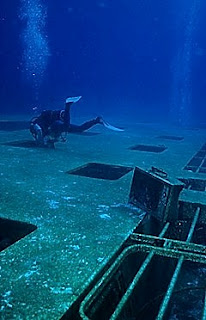
During our initial dive on the Salem Express, it became clear to us that we were not the first divers to visit the wreck. One of the earliest clues was the sight of a portable television perched on the side of the hull in a spot where it was unlikely to have landed all by itself. It was obvious that it had been placed there by someone who had found it elsewhere in or near the sunken vessel. Salem Express wreck, Red SeaThat television was the first of the many personal belongings we would see during our three dives on this wreck -- items that must have belonged to the passengers who were on board the night the ferryboat sank in the Red Sea.
As I mentioned previously, we got to dive on the wreck of the Salem Express while it was still quite fresh. We knew that the remains of many of the several hundred passengers and crew who had lost their lives in the accident had never been recovered, and were presumed to be entombed inside the wreck. With that in mind, we took care to treat the scene with respect, and we agreed amongst ourselves that we would not take anything from it. We took no souvenirs except photos, and there were some things we saw that we did not even photograph.

The personal effects scattered about the site of this wreck were so many! When we all talked afterward about what we had seen, we discovered that each of us had had similar thoughts while looking around: wondering who these things had belonged to, and imagining how terrifying that night must have been for them.

At the time it sank, the Salem Express had been nearing the end of a regular run from Jeddah, a port on the Saudi Arabian side of the Red Sea, to Safaga, on the Egyptian side. News reports about the disaster had mentioned that many of the passengers were returning home from a religious pilgrimage to Mecca. Others were Egyptian workers employed in Saudi Arabia, coming home to visit their families. Some passengers were citizens of Saudi Arabia and other Middle Eastern countries: there were businessmen, as well as couples and families en route to Egypt for a sight-seeing holiday. They almost made it. The ship went down in sight of the lights of the port.

It was easy to imagine passengers out on the promenade deck, leaning on the rails and watching those lights on the coastline as the ferryboat approached Safaga. Others would have been belowdecks in their cabins, packing up their belongings, anxious to drive their cars off the ferryboat as soon as it reached the dock. The passengers might have been excited, or just relieved to be near the end of their journey. In any case, they had been real people with real lives and families.

Now all that remained were some of their possessions, scattered in and around the wreck -- clothing, shoes, handbags, toys, electronic gadgets -- all covered with a film of greenish algae. Some things, like books and notebooks, already were beginning to decay. Other things -- the TV, a child's plastic toy airplane, a set of prayer beads -- probably would remain intact for quite awhile.

Propeller on the Salem Express wreckJerry and I had decided that we wanted to have a look at the ship's two propellers, so at the outset of this final dive we swam straightaway to the stern area of the ship. Jerry posed for a photo between the big blades of one propeller, and then we descended the rest of the way to the sandy bottom to join some other divers poking around in the debris trail astern of the ship.

One of the divers discovered a small suitcase there. It was an old-fashioned, inexpensive looking one made of heavy cardboard with a little bit of leather trim on the edges and two metal clasps to fasten it shut. While we hovered a little above to watch, the diver knelt in the sand by the suitcase and tried the clasps. Amazingly, they popped right open, so he lifted the lid.

Inside the suitcase were clothing items, still nicely folded in two stacks, with a shoe tucked along each side. The diver took an item from the top of the one stack and held it out in front of him. It unfolded. It was a child's striped tee shirt. The diver refolded the tee shirt, laid it back in the suitcase and closed the lid -- and the clasps. He knelt there for at least another minute, just staring at the closed suitcase. We quietly swam away, leaving him alone with his thoughts.

Jerry signaled to me to swim with him along the side of the ship, heading toward the bow. Every few feet we saw another object. That's where we saw the toy airplane, and then the prayer beads, among other things.

When we were almost to the lifeboat that I had photographed the day before, Jerry spotted something that at first looked like a small book. He picked it up from the sand to examine it. It was a passport. Jerry opened the cover, turned a page or two, and then turned to me looking very agitated. He was jabbing his finger at a page as he held the passport out to me. Through the faceplate on his dive mask I could see his expression -- one we call 'fried egg eyes.'

I took the passport from him -- I'm sure I was frowning -- and looked at the page he'd been pointing to. I saw then what had made him so agitated. The passport, though soggy, was reasonably intact -- a testament to the sturdy paper those are made of, I guess -- and the indelible ink of the visa stamps also had endured these seven months under water. The photo -- or rather what had been the photo -- was still attached. The paper part of the photo was there, but I was astonished to see that there was no face! The emulsion had washed away over time. The photo was blank. Gone! For a moment I almost forgot to breathe. Now it was my turn to have fried egg eyes. (And just writing this still gives me 'chicken skin.')

Jerry took the passport out of my hand and swam over to the sunken lifeboat. He laid the passport down inside the lifeboat, and signaled to me to ascend. I nodded. This dive was finished for us. We had lost all motivation to look around at any more of the wreck or its debris.
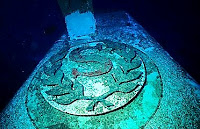
Samatour Shipping Company logoWe went to our assembly point on the port side of the hull and waited for the other divers. They arrived in a few minutes, and we all began our final ascent together. As we had done on the previous two dives, we all hovered at a depth of five meters while one diver surfaced to signal our boat.

While we were hovering one of the divers reached into the pocket of her dive vest and brought out a small white teapot. It was the size that would have held two cups of tea, and it had the shipping company's logo on it -- the same "S" between laurel leaves displayed on the ship's funnels. She held it out for a moment for all of us to see, then she purposely let it fall. The last thing we saw before we surfaced was that little teapot tumbling and twirling its way back down to the wreck.

We've never been back to that wreck, but we know that many other divers have visited the Salem Express over the past 15 years. Recently Jerry came across a YouTube video that had been shot there earlier this year. We like the video. It was nice to see so many soft and hard corals growing on the superstructure of the ship, the bannerfish near the winches, and tube sponges on a propeller blade. Best of all is the anemone on the promenade deck, complete with a resident clownfish. Go and have a look: Salem Express - Mar Rojo 2007. (And thanks to YouTube user Angel Manso from Madrid for posting the video.)

---------------------------------------------------

Here are the links to all five parts of this story:

Part 1: What a wreck!
Part 2: A dream trip, a storm, a mutiny, and a consolation prize
Part 3: Ninja divers: First dive on the Salem Express
Part 4: Inside the wreck of the Salem Express
Part 5: The Salem Express wreck -- A human tragedy

Inside the wreck of the Salem Express

This is the fourth post in a series about diving on the wreck of the Salem Express, a ferryboat that sank in the Red Sea near Safaga, Egypt in December of 1991. Here's the link to the first post in the series: What a wreck!

In the previous post, we told about our first dive on the Salem Express. That was a survey dive, just to look over the scene and get a general idea of what the wreck looked like, how big it was, and the water depth. Afterward we were able to produce a rough diagram of the vessel and the immediate area from memory, and to fill in details such as the depth at various points from notes we had made on our slates. We used this information to plan our two remaining dives.

After conferring, it was clear that there were two things that interested all 12 of us. We wanted to see the inside of at least part of the wreck, and we wanted to look more closely at some of the debris scattered about, especially the many personal items we had spotted that must have belonged to passengers who were on the ferry at the time it sank.

We decided that the objective of our second dive on the Salem Express would be exploration of some interior areas of the vessel that were readily accessible. This would require coordinated teamwork to accomplish. Then for the final dive, we would fan out in a free-ranging way to look at whatever we wished.

On the survey dive, no one had gone inside any part of the sunken ship. We all had agreed to that rule ahead of time, for safety reasons.

What's the big deal about that?

First, the interior of a wreck is an example of what divers refer to as an 'overhead environment.' When there is something overhead, literally -- some barrier between the diver and the surface -- a diver cannot make a direct ascent to the surface in case of an emergency. Diving in an overhead environment requires that certain precautions be taken to compensate for the fact that the diver can't ascend directly. For example, an alternative source of air will be taken along, so that if the primary source fails for any reason, the diver can switch to the alternative source while exiting the overhead environment.

Natural wrecks pose other dangers as well. There are broken things and loose parts that can ensnare or injure a diver. It's dark inside wrecks, so a good light source is needed -- plus a backup. Divers who penetrate wrecks (and caves) usually lay a guideline as they go, so that they can be sure to find their way out again. Sometimes silt or other matter that has settled inside will be stirred up as a diver swims through. When this happens, visibility can be greatly reduced in no time. Believe me, it's very easy to get completely disoriented in murky water.

Since we hadn't expected to dive on a wreck on this trip, no one had brought along the sort of gear that normally would be used for wreck penetration dives. Still, we were more than a little curious about what we might see inside the two most accessible interior areas of this wreck -- the lounge/snack bar that our team had peeked into on the first dive, and the bridge that the 'bow team' had seen. We decided to improvise.

After some discussion, we came up with a workable plan. We had enough bits of gear among us to equip two teams satisfactorily for penetration. We decided that one pair of divers would penetrate the lounge/snack bar, and another small team would penetrate the bridge. The rest of us would act as support teams to ensure the safety of those who went inside the wreck. (It was, if nothing else, a wonderful example of cooperation among the divers.)

One couple had an underwater video camera, and their video rig included a set of very bright lights. They got elected to enter the lounge/snack bar -- the larger and deeper of the areas that would be penetrated. Their video lights would be a reasonable primary light source, and the added benefit was that they could shoot video of whatever they came across so that the rest of us could see it later.

bridge of the Salem ExpressThree divers, including Jerry, got to penetrate the ship's bridge. I took the photo at right when the divers were still inside the bridge. You can clearly see the bubble streams of the three divers.

What do you suppose they found?

The team that went inside the bridge reported that the ship's wheel was still in place, as were all of the navigation instruments and control panels. They also noticed a set of soggy marine charts, and a star chart.

One of their most interesting finds was a set of signal flags made of colored canvas cloth, stored in a cabinet divided into pigeonholes. Each flag was neatly rolled up inside its own pigeonhole. Jerry brought two flags outside the wreck to show the rest of us, then rolled them back up and went back inside to return them to the pigeonholes where they had been found. (We had all agreed that we would take no 'souvenirs' from this wreck.)

The divers who went into the lounge and snack bar did a great job of shooting video there. There was a soda machine still bolted to the room's forward bulkhead. There were tables bolted to the floor, now sticking out sideways. Since the ship was lying on its starboard side, all of the chairs had ended up against the starboard bulkhead in a heap, along with a range of hand baggage and other personal items. One item they brought out to show the support divers was a 'boom box' cassette player. It still had a cassette inside, and the 'play' button was still depressed. It made us feel very sad.

The most eerie video footage was of a sign in the lounge. It was attached to the forward bulkhead at what must have been eye level when the ship was upright. It was an exit sign, and included a large arrow pointing to a companionway that led to the promenade deck on the port side of the ship. Because the ship was lying on its side now, everything was at a right angle to what it had been before the ship sank. When the ship was underway, the arrow on the sign had pointed left, to the companionway. Now that the ship was lying on its side, that arrow pointed up, toward the surface!

Our time was up, too. The mission of the dive had been accomplished, and -- since we had entered the water just before dusk to reduce the chance of detection -- it was getting quite dark. We ascended according to plan and our charter boat picked us up right on schedule. Early the next morning we would make our final dive on the Salem Express, and we would make our most startling discoveries. We'll tell you about those in the next post.

---------------------------------------------------

Here are the links to all five parts of this story:

Part 1: What a wreck!
Part 2: A dream trip, a storm, a mutiny, and a consolation prize
Part 3: Ninja divers: First dive on the Salem Express
Part 4: Inside the wreck of the Salem Express
Part 5: The Salem Express wreck -- A human tragedy