Showing posts with label adventures. Show all posts

Living on the Wreck of the Zenobia: A Mediterranean Moray

Mediterranean Moray (Muraena helena)
by B. N. Sullivan

This is a Mediterranean Moray (Muraena helena).   We discovered this individual while diving on the Zenobia, a large shipwreck in Larnaca Bay, Cyprus. The eel was living in an algae-encrusted drain near what had been one of the big ship's lifeboat stations.

The Mediterranean Moray is known to be territorial (like many other species in its family, Muraenidae).  Thus, we were not surprised when the local dive guide who was escorting us told us that this particular Moray had been residing there for quite awhile, and usually could be seen poking its head out of the same hole on any given day.

This is a carnivorous species.  A nocturnal hunter, the Mediterranean Moray preys on fishes and crustaceans.  This eel also will scavenge dead animal carcasses.

Note:  The photo on this page was taken in 1992, during one of seven dives we made on the wreck of the Zenobia. In 2008,  I wrote about those dives in a series of articles on The Right Blue.  If you are interested, you can have a look at these posts about our dives on the Zenobia:


Finally, here is a link to a recent documentary video about the Wreck of the Zenobia.  The underwater videography is good, and the wreck itself looks much the same as when we saw it years ago.  It looked to us as though many more fish now call the wreck home -- but, alas, we saw no sign of our Mediterranean Moray.

UPDATE:  Okay, we just looked at the film again, and guess what we saw: A moray! [at about 23:24 minutes].  There's no way to know if it's the same moray, or another of the same species, but in any case, the wreck of the Zenobia does still have a resident Mediterranean Moray.

Diving the Wreck of the Dunraven in the Red Sea

by B. N. Sullivan

DunravenThis is the third post in a series about the wreck of the Dunraven, a 19th century cargo ship that sank in the Red Sea on April 25, 1876. The ship went down after hitting rocks off the coast of the Sinai peninsula. The rocks pierced the forward section of the vessel's hull, causing it to fill with water and sink. The first photo on this page, at right, shows divers examining the large hole in hull that ultimately sank the Dunraven. (Earlier this week I wrote about the history of the ship and how it met its end, and some wide-angle photos of the wreck. )

Today's topic is diving on the wreck of the Duraven. The photos in this post have been reduced in size. If you click on the photos to enlarge them, you will be able to see more detail.

We have dived the Dunraven on a number of occasions. As wreck dives go, it is a fairly easy one. It does not really require specialized wreck diving skills, however divers who visit the Dunraven should get a detailed briefing ahead of time from a qualified dive guide about what to expect, especially if they intend to penetrate the vessel. Prior to the dive you should know about the layout of the vessel, the route you will follow, and the conditions at the site. If this information is not volunteered by your dive guide, ask!

By the way, the bottom at the site of the wreck is at roughly 30 m (100 ft), so divers who visit the Dunraven should be prepared for that depth.

As the Dunraven sank, its water-filled hull capsized, and it settled onto the bottom upside down. Today the ship's inverted hull is split in two at about the midpoint of its length. The opening there makes for easy entry to the inside of the wreck by divers: A standard dive on this wreck entails entering there, swimming forward through the wreck, and exiting through the hole in the bow that was created by the impact that sunk the vessel.

Here, divers are approaching the large break in the middle of the hull, where they will enter the wreck:

Dunraven

The inside of the wreck is dark, so it is necessary to bring along bright hand-held lights in order to find your way through the vessel, and also to see features of the ship's interior, its boilers, and the marine creatures that now call the Dunraven home.

Some of the divers in our party did not want to penetrate the wreck. I took this photo from inside the wreck while they were peeking at us from the outside, through a hole:

Dunraven

Large, dense schools of Glassfish live permanently inside the Dunraven. Divers must swim through these schools of fish as they pass through the wreck. Also seen frequently inside the wreck: Squirrelfish, Bigeyes, and Lionfish.

In the photo below, divers are swimming through a swarm of Glassfish and exiting the wreck via the hole in the bow:

Dunraven

Having been at the bottom of the sea for well over 100 years, the exterior surfaces of the Dunraven are totally encrusted with corals. Many small creatures live amongst those corals, and it is worth taking the time to poke around to find creatures such as Nudibranchs, and Pipefish. You might also spot a bottom-dwelling fish such as a Stonefish or Scorpionfish alongside the hull where it touches the sand.

Here is a photo of Jerry swimming along the bottom, outside of the wreck of the Dunraven. You can see how the hull is completely covered with marine life:

Dunraven

One word of caution to divers who intend to visit the Dunraven: the area is prone to strong currents. Here is Jerry, swimming near the Dunraven. You can see by the angle of his bubble stream that he is swimming across a substantial current:

current

When a current is running, a good way to dive this site is to have a boat drop you right over the wreck site, and then pick you up 'downstream' at the end of the dive. It is important, in such cases, to descend to the wreck quickly, before you are swept away. A good plan is to explore the wreck, and then ride the current while gradually ascending along the face of the nearby reef wall to a downstream pick-up point.

The beautiful reef wall that is adjacent to the wreck of the Dunraven is very lush. The wall is well populated with fish, crustaceans and corals of many types. You also may encounter larger fish in the area, such as Napoleon Wrasse, Barracudas, Sharks and Stingrays.

Related:

The Dunraven, a 19th Century Shipwreck

Wordless Wednesday
Watery Wednesday

What: Wreck of the Dunraven, a 19th Century British cargo ship.
Learn about this shipwreck here.
(Come back on Thursday for a post about diving on the wreck of the Dunraven.)

Where: I took these photo in the Red Sea,
near the southernmost tip of Egypt's Sinai Peninsula.

Click on the photos to enlarge.

Dunraven

Dunraven

History of the Dunraven, a Shipwreck in the Red Sea

by B. N. Sullivan

Dunraven wreckA popular dive site in the northern Red Sea is the wreck of a ship called the Dunraven. This shipwreck is located near the southernmost tip of Egypt's Sinai peninsula, close to a landmark called Beacon Rock (AKA Sha'ab Mahmoud), near the mouth of the Gulf of Suez.

Today we will review the history of the Dunraven. In the next two posts, we will present more photos of the Dunraven, and tell about diving on the shipwreck.

The Dunraven was a British cargo vessel that was built, operated, and sunk in the late 19th century. Over the years since the vessel's remains were discovered by divers, many stories have been circulated about the history of the Dunraven. At one time it was thought to have been either a spy ship or a treasure ship associated with Lawrence of Arabia. These stories later proved to be false. Instead, it appears the Dunraven had a far less romantic history.

The Dunraven was built in England, at Newcastle, and launched in 1873. Like many of the most modern vessels of that era, she was powered by both steam and sail. The ship was nearly 80 m (260 ft) long, with a beam of just under 10 m (33 feet).

The Dunraven plied the route between England and India. On what turned out to be her final voyage, the ship had carried timber and steel from Liverpool to Bombay, and was making the return trip laden with general cargo when tragedy struck. According to historical data about the vessel compiled by Ned Middleton, the Dunraven left Bombay on April 6, 1876 loaded with cargo bound for Liverpool. The ship, with her crew of 25, crossed the Indian Ocean in good time and entered the Red Sea, stopping at Aden for coal. She continued northward through the length of the Red Sea, apparently headed for the Suez Canal.

DunravenIn the wee hours of April 25, 1876, the Dunraven, running at full speed under steam power, was approaching the mouth of the Gulf of Suez. As the story goes, a sailor on watch spotted a large dark object, and thought it was a buoy. The Second Mate also saw the object and thought it was a boat.

In any case, the Captain ordered the engines stopped, but it was too late. The ship hit what turned out to be rocks, and the hull was breached at the fore compartment (see photo at left).

Middleton writes:
The steam pumps were immediately set to work and a fruitless attempt was made to heave her off by means of a kedge anchor. By 7am, the water reached the engine room and put out the fires. By midday the starboard side of the upper deck was under water and the Master and crew took to the lifeboats. They remained with their doomed vessel and at 4pm an Arab Dhow came alongside and took the shipwrecked mariners on board. It was only at this time that the Master of the Dunraven was made aware if his actual position - off the southern tip of the Sinai Peninsular.

At 5 pm, the Dunraven slipped off the reef and sank in 15 fathoms (27 m) of water. For three days the Dhow lay at anchor over the Dunraven until Captain Care and his crew were transferred to the passing Italian steamer "Arabia" which conveyed them to Suez. The Peninsular and Orient steamer "Malwa" later transported them all back to England.
Tomorrow, we will post some more photos of the wreck of the Dunraven for Wordless/Watery Wednesday. Then, later in the week, we will tell about diving on the this famous shipwreck in the Red Sea. Stay tuned!

Perceived Risk, and Point of View

by B. N. Sullivan

Our blogger friend Sheila Beal posted an adventure story (with pictures and a short video) on her Go Visit Hawaii blog earlier today. In the story she told about a thrill ride she and her husband tried during a recent visit to Kauai. It's called a zip line.

Here's Sheila:
When we approached the first zip line, a 170-foot “bunny” line, I got butterflies in my stomach and that internal chicken was obnoxiously loud. Our guides did a great job of giving us safety pointers and telling us what to expect. So, with excited reluctance, I climbed to the platform, allowed John to hook my harness to the line. I watched him pull on the harnesses and double check the connection for safety. I asked again what I needed to do and John kindly explained it all to me again. I said a prayer, took a deep breath, and ran off the platform. It was fun and I survived.
Sheila's husband took his video camera along on his zip line ride, filming a blur of foliage during the short, fast trip -- accompanied by a clearly audible yell that is part Tarzan, and part terror.

I left a comment on the blog, saying you could never get me to do that! Sheila replied that she thinks we are the brave ones, because we dive. Well, I suppose it's all a matter of perspective.

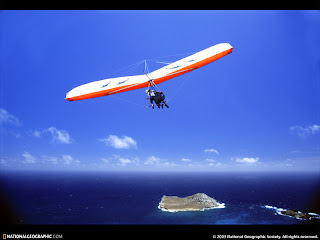
Hang glider at Waimanalo, HawaiiThis exchange reminded Jerry and me of an experience we had years ago, when we were still living on Oahu. One day we gathered up our dive gear and went to an area near the eastern tip of the island to dive. We entered the water from an area near Makapu'u Beach, right across the road from Sea Life Park.

As we were preparing to enter the water, we saw several hang gliders wheeling around in the sky directly overhead. This is not an uncommon sight in that area, since one of the favored launch sites for hang gliders is Kamehame Ridge, directly behind Sea Life Park. We could see the edge of the launch platform at the top of the very steep, very high cliff, and it always made us shudder to see someone launch, hanging onto what looked like a very flimsy kite. We'd always look at each other, shake our heads, and say how crazy those hang glider pilots were.

Well, on this particular day, we saw one of the hang gliders come in for a landing on a grassy patch, just steps from where we were wading ashore at the end of our dive. We had never seen a hang glider up close, so we took off our heaviest gear, and -- still wearing our wetsuits -- walked over to have a look.

The hang glider pilot was just beginning to disassemble his rig as we approached. He looked our way and said hello. We struck up a conversation, asking him lots of questions about the glider, about what the ride felt like, and so on. He raved about the experience of hang gliding, and was barely short of rapturous about the views he saw, and the sheer joy he felt while soaring. He said, "If you are interested, why don't you come on up to the ridge some time and try it. Several of our club members can give tandem rides."

As I recall, we literally backed away a bit as we shook our heads and told the guy that we couldn't imagine jumping off a cliff on a hang glider. Too scary! This prompted him to tell us, at some length, all the reasons why the sport was not nearly so risky as most people believed. Again we demurred, but said we might hike up to the launch site one day to watch from that vantage point -- we just didn't want to "make the leap", as it were.

The hang glider pilot threw his head back and laughed. He said, "I saw the two of you swimming in toward shore while I was descending. Scuba diving -- now THAT's a risky sport!"

Of course, that prompted us to go on at some length about how scuba diving really was not all that risky, as long as you were properly trained, followed your training, kept your equipment well-maintained, and so on. The hang glider pilot kept interrupting us with questions like, what if you run out of air; what if you get bad air in your tank; what if you see a big shark; what if a boat runs you down just as you are surfacing? It seemed that no matter what we said, there was no way we could convince the hang glider pilot that scuba diving was a safe sport.

A clear case of 'never the twain shall meet'? Or maybe a version of 'one man's meat is another man's poison'? Pick your metaphor, but the point is the same. Perceived risk depends on your point of view, and that in turn probably depends on what you have learned, either formally through training, or from experience.

We both are good swimmers, and we always have felt comfortable in and under the water, even in conditions that are not optimal. But we still wouldn't jump off a cliff on a hang glider -- and we will leave the zip line adventures to Sheila and Andy!

About the photo: Taken by Jodi Cobb for National Geographic, it is titled "Hang Glider, Waimanalo, Hawaii, 2000." Given the location, and the recognizable islet in the photo, the hang glider likely launched from Kamehame Ridge. The photo is available as a computer wallpaper. Click on the photo above to visit the page where you can download it for free.

For more photos of hang gliders launching from Kamehame Ridge, visit this page at Tim's great photography website, Pa'iki'i Imagery.


UPDATE Feb. 3, 2009: This article is featured in the February 2009 Carnival of Aloha, a blog carnival with a Hawaii theme, hosted by Evelyn at Homespun Honolulu. Go and have a look!

Fish Tales: Encounters with the Napoleon Wrasse

by B. N. Sullivan

Imagine that you are on a dive boat in the Red Sea. The boat has just tied up to a mooring at a place called Jackson Reef in the Tiran Straits. All geared up, you jump off the stern platform of the boat and begin your descent. As you drift down gently through the water column, something off in the distant blue catches your eye. At first all you can make out is a hulking shape that looks vaguely like a Volkswagen beetle, and it is moving toward you. As it lumbers along, the shape tilts this way and that, and as it gets closer you are able to make out pectoral fins, big eyeballs, and huge fat lips. You realize it's definitely not a Volkswagen; it's a great big fish - A Napoleon Wrasse.

Cheilinus undulatusEarlier this week, for Wordless Wednesday, I posted a photo of a Napoleon Wrasse. Readers commented on the size of the fish, on its shape, and on its prominent eye.

These guys definitely are big: adults usually are close to four feet in length, although I read somewhere that there have been reports of older males of the species occasionally reaching a length of about six feet. Females tend to be smaller. In any case, they are said to be the largest species in the Wrasse (Labridae) family.

They are heavy-bodied, and weigh several hundred pounds. Because of their bulk, they usually lumber along, but make no mistake - they are capable of very quick speeds, too, at least over short distances.

Their eyes are large, and each can move independently. The eyes protrude and rotate in a way that might remind you of the ball turret on a World War II B-17 aircraft (without the gunner). When they are close to you, they tend to tilt to look at you with one eyeball, much as a chicken would.

The common name, Napoleon Wrasse, arises from the prominent bump that protrudes from the foreheads of fully grown adults, giving them a profile that is reminiscent of Napoleon Bonaparte with his hat. Another common name for the fish is Humphead Wrasse -- take your pick -- but in either case, the scientific designation for the species remains the same: Cheilinus undulatus.

Cheilinus undulatusThese fish can live for thirty years or so, and they seem to have long memories. When we first began to dive in the Red Sea a few decades ago, dive guides there sometimes would entertain their clients by hand feeding boiled eggs to the Napoleon Wrasses. After awhile, once everyone finally realized that this was not an ecologically sound thing to do, this practice was banned.

Unfortunately, no one sent a memo to these fish to tell them not to expect boiled egg handouts from divers. For years after the practice of feeding them boiled eggs had stopped, the Napoleons still converged near dive boat moorings as soon as they heard the sound of the boats' engines approaching. There they would lurk until they spotted divers descending, at which point they would approach the divers at quite close range, hoping for a free snack.

Sometimes the Napoleons would do more than wait. If a diver reached into the pocket of his vest for any reason, the Napoleon would quickly swim right up to that diver in anticipation, sometimes nudging the diver with those great big fat lips. We've heard countless of stories of divers who had to physically push a Napoleon away from them repeatedly before the fish finally got the message that they had no eggs to hand out.

In an extreme case that we actually witnessed, a friend who was diving with us lost an important piece of gear to a Napoleon, and almost lost his hand as well.

For the benefit of our non-diving readers, let me first explain that these days, scuba regulators (the device that reduces the pressure of the compressed air in the cylinder so that it can be breathed) usually have two second stages, i.e., the part that includes the mouthpiece. The primary one will be used by the diver to breathe underwater. The secondary one, though fully functional, is a back-up. As such, it is usually attached to the diver's vest by a clip or similar means, or stuffed into a pocket.

So then, on this particular dive, the clip that usually held our friend's back-up second stage had broken. Rather than let the device trail behind him, he held it at waist level, cupped in his two hands, as he swam. Now, these devices come in a wide variety of colors. Our friend's happened to be white. (Can you see what's coming?)

Cheilinus undulatusAlong came a Napoleon. It saw the round white shape cupped in our friend's hand and apparently mistook it for an egg. First the fish swam back and forth excitedly around our friend. Then it nudged him. Annoyed, our friend put out one hand to push the aggressive fish away. At that instant, the Napoleon lunged and snapped the white regulator out of our friend's other hand -- or tried to. The regulator was attached to a hose, of course. When the Napoleon bit, the hose partly detached and it began to froth like crazy from the rapidly escaping compressed air. That scared the fish, which went zooming past us with our friend's glove hanging from its mouth!

That was the end of that dive: time to initiate emergency procedures. A fourth diver who was with us immediately handed off his back-up second stage to our stricken friend so that he could breathe. Meanwhile, Jerry swam around behind him to turn off the valve on his cylinder, stopping the uncontrolled flow of air. Then, with the two divers sharing air, we all swam back to the boat.

Once on board, we inspected the damage. The hose had to be replaced, and although the white second stage that had been bitten probably could have been repaired, our friend announced immediately that he would replace it -- with a black one! No one ever saw the glove again, but our friend was happy enough to have relinquished it, since he still had his hand.

By the way, we have seen Napoleons elsewhere -- especially in the waters around Malaysia and Indonesia -- but only the ones in the northern Red Sea were so bold. The ones we saw in other places tended to keep their distance from divers. Apparently they had not been fed by divers. In fact a dive guide in Indonesia told us that Napoleons had been a favorite target of spear-fishermen there until quite recently; thus, they had learned to be wary of humans underwater.

About the photos on this page: Each image shows a different individual Napoleon Wrasse, and each was photographed on a different dive. I took all three photos in the Red Sea: the top photo was taken at Jackson Reef in the Tiran Straits; the other two photos were taken at Ras Mohammed, near the tip of the Sinai Peninsula. And in case you are wondering, the Napoleon in the third photo is not about to bite the leg of the diver on the left. It's an optical illusion created by the wide angle lens. The wrasse actually was positioned between the two divers.

The Day We Met the Landlord

by B. N. Sullivan

If you ask someone to name a large, predatory shark a likely response is the Great White Shark (Carcharodon carcharias). That was the species featured in the film Jaws as the villain -- albeit in greatly exaggerated form. Thanks in large part to that film, sharks in general, and Great Whites in particular, tend to evoke fear in the minds of many people.

There are occasional sightings of Great White Sharks in Hawaiian waters, but the Tiger Shark (Galeocerdo cuvier) is generally acknowledged to be the top predator shark in tropical seas around the world, including Hawaii. There have been very few documented cases of attacks on humans by Great White Sharks in Hawaii, but about once a year, on average, someone is bitten by a Tiger Shark in the our waters. I should add that most of these 'attacks' are not fatal. Far more people drown than are killed by sharks: there are about 50 drownings per year in Hawaii, according to the Hawaii State Department of Health.

Tiger SharkThat said, the Tiger Shark still commands considerable respect. In fact, some surfers we know refer to the Tiger Shark as "The Landlord." That Landlord is imposing in size -- up to about 18 feet (550 cm) in length -- and is known to have an equally big appetite. It eats various kinds of fish, including other sharks. It also eats octopuses, crabs, lobsters, and sea turtles (which it can swallow whole).

The Tiger Shark can swim long distances in the open ocean, but tracking studies carried out by the Hawaii Institute of Marine Biology Shark Research Group have shown that the species also spends time in coastal areas. Every now and then, Tiger Sharks are spotted fairly close to shore by fishermen and surfers, and they are seen occasionally by divers as well.

In an earlier post, I promised to tell about our first and only encounter with a Tiger Shark while diving at Puako, on the Big Island of Hawaii. As I mentioned previously, we reckoned we would cross paths with a Tiger Shark sooner or later, since we spent so much time in and under the water. But when it finally happened, the where and when and how were completely at odds with what we had imagined would be the case. In fact, everything about the encounter was a surprise.

Early one fine November afternoon, we entered the water from shore for our second dive of the day. Although we have been known to cram as many as five dives into each day of a dive trip, at home we seldom do more than one dive on any given day. On this particular day, though, we had been working on an offshore project during our early morning dive (more on that in a later post). Before we had finished our underwater tasks, we ran out of time and had to ascend. So, after we surfaced we decided to rest for a couple of hours, get fresh air cylinders, and make a second dive.

We had decided ahead of time that on the second dive, we would complete the tasks we had begun during the morning dive as quickly as we could, and then spend the rest of the dive in relatively shallow water. According to my dive log, both dives had been to a maximum depth of about 125 ft (38 meters), so it was prudent to spend as long a time as possible in shallow water at the end of the second dive 'off-gassing' some of the nitrogen our bodies had absorbed at depth.

This procedure is an easy and pleasant thing to do at Puako, thanks to the underwater topography. The inshore edge of the fringing reef at Puako is at the base of a cliff-like dropoff created by old lava flows. For long stretches, the depth at the base of the dropoff is between 20 and 30 ft (roughly 6 to 10 meters), ideal for decompressing after a deeper dive. The best part is that the dropoff is not straight. It meanders in and out, and there are canyons and cavelets, and arches -- all kinds of nooks and crannies to explore, and all of those full of critters. In short, you'll run low on air long before you run out of things to see there.

We spent most of our shallow time that day in a particular canyon that was less than a ten minute swim from our exit point. We looked for shells, we watched an octopus pair who were courting, we saw a lobster hiding in a cavelet, we spotted a scorpion fish perched on a rocky shelf -- all very enjoyable and entertaining. Our time was nearly up, but since we were so close to shore, we were not in a hurry to leave.

We pottered along toward the mouth of the canyon, where we would round an outcropping and then swim into the next canyon. That canyon would lead us to our exit point. This was a backyard dive. We knew the route and the terrain by heart.

Conditions that day were about as ideal as they could be. According to the notes in my logbook, both the water temperature and the air temperature were 80 F (27 C). There was virtually no wind, and the surface was calm and glassy. Horizontal visibility underwater was about 125 ft (38 meters). So, as we left the mouth of the little canyon, we could see the vast coral garden very well.

I looked out across the expanse of coral. While I hovered there, enjoying the view, I spotted something unusually large swimming along the far edge of the coral garden. There had been several sightings of a juvenile Whale Shark in the area during the past week, and I thought immediately that's what it must be. Jerry was following a short distance behind me, so I banged on my scuba tank to get his attention, and pointed toward what I thought was the junior Whale Shark. When I banged on the tank, the big fish heard it, too. It changed course immediately and began swimming straight toward us. "Oh, goody," I thought. "What a treat."

As it swam in our direction, we had a head-on view. I noticed that it had a wide blunt snout, a feature that momentarily confirmed in my mind that it was indeed a juvenile Whale Shark. Then, when it was about 20 feet (6 meters) away from us -- and just as I was about to swim toward it to meet it, and maybe even pet it -- it turned a bit, to alter its course. The instant it turned I could see the markings on its flanks. The flash of realization hit me: this was no Whale Shark, it was a great big Tiger Shark! We were meeting the Landlord.

The big fish sort of glided past us, and then continued on its way -- no rush, no hurry -- heading northward along the reef. My heart was pounding then, I admit, but I felt excitement rather than panic. I even had the presence of mind to take a mental snapshot of the Tiger Shark as it passed in front of me: the nose was right above that coral head, and the base of its tail was over this one. The next day we returned with a measuring tape and, playing it out between the landmarks I had committed to memory in that instant, we determined that the shark was roughly 12 to 13 ft (about 4 meters) in length.

Tiger Shark - National GeographicAt the moment, though, all we knew was that it was big, and that it was a Tiger Shark, and that it was right there! The last we saw of it -- and the image sticks in my mind clearly to this day -- was the tall dorsal lobe of its tail, gently sweeping back and forth as it swam away from us, unhurried. It was elegant.

When it was completely out of sight, I turned to Jerry. He was hovering there in the water, hands calmly folded at his waist, just staring after the shark.

In a moment of Supreme Duh, I made the hand signal for 'shark.' Jerry nodded. I stretched both my arms out wide, and then signaled 'shark' again: B-i-i-i-g-g Shark! Jerry nodded again. I held my left arm horizontally across my waist, and with the index finger of my right hand, I drew imaginary hash marks along my forearm, then signaled 'shark' again: Tiger Shark. But by then Jerry was no longer watching me tell him the obvious with my hand signals. He seemed more interested in his dive computer.

Jerry turned his computer toward me so that I could see the face the instrument, and pointed at the numerals it displayed. I thought he was trying to tell me that we were out of time (which we nearly were) and that we should end the dive. No, he was showing me the depth. We were hovering at just barely 20 ft (6 meters). Jerry pointed in the direction of where we had last seen the shark, then pointed at his computer, and wound up the wordless communiqué with the hand signal for 'crazy.' He was telling me he couldn't believe we had seen that Tiger Shark at such a shallow depth.

Indeed, we always had imagined that if we saw a Tiger Shark, it would be in deep water, and well offshore. We also had been led to believe that we were more likely to see one around dawn or dusk. We never, ever imagined that we would see one just after midday, in less than 30 feet of water, right along the edge of the dropoff, so close to shore. We had just come face to face with a big Tiger Shark, but it was at a time and place we never would have predicted. It was a little hard to take in.

Then, via another flurry of hand signals, we agreed it was time to swim to our exit point, but with one of us swimming face-forward, and the other swimming backward. Just in case the Tiger Shark decided to circle around and come by for another look at us (as sharks sometimes do), we wanted to spot it as soon as possible. It didn't come back. Anyway, when we saw it, the shark did not appear to be hunting. Rather, it was in sightseeing mode -- just cruising through -- and we were merely one of the sights.

One more thing. After we waded ashore, we both turned around and looked out to sea. I think we half expected to see some evidence of the Tiger Shark -- a dorsal fin, perhaps? Of course we didn't see any sign of it, and it had been silly to think we would have. What we did see was a catamaran that serves as a snorkel charter boat, tied up at a mooring on the reef, just a stone's throw from where we had seen the Tiger Shark. There must have been a dozen or so people -- tourists from a resort down the coast -- paddling around, splashing on the surface.

We wondered aloud what they would do if the Tiger Shark suddenly appeared beneath them. A few minutes later, we saw that the catamaran crew were beginning to help the snorkelers back aboard the vessel, but without any urgency or excitement. Their time was up, their snorkel excursion was finished, and they had missed meeting the Landlord.

About the images on this page: The first image was scanned from page 76 of the book, Sharks of Hawaii, by Leighton Taylor, (Honolulu: University of Hawaii Press, 1993).

The second image, a photo of Tiger Shark just below the surface, by Bill Curtsinger, for National Geographic. Click on the photo to download it as a wallpaper from the National Geographic website.

More About Tiger Sharks:


Tiger Shark Research Program, Hawaii Institute of Marine Biology, University of Hawaii

Tiger Sharks, Florida Museum of Natural History

Sipadan Turtle Cave: The Video

The story I wrote last month about The Cave Where Turtles Die, at Pulau Sipadan, has turned out to be the most popular story ever published on The Right Blue. I guess it just captured people's imagination.

Now a reader has alerted us to a video of the Sipadan Turtle Cave, produced and posted to YouTube by Dutch diver Paul Vermeulen. It looks to us as though the diver only visited the first chamber of the cave -- or at least that is all he filmed. Watch for shots of the entrance to the cave, shot from inside. Spooky!


(If the video does not play or display properly above, click here to view it on YouTube.)

Sipadan Island - Being there, Part 3

by B. N. Sullivan

Malaysian fishermenThis is the third in a multi-article series about Pulau Sipadan, a magical dive destination off the coast of Borneo. If you have read Part 1 and Part 2 of this series, you know that the accommodations at the 'resorts' on Pulau Sipadan in 1993 were rather spartan. One thing that was not lacking, however, was excellent food.

There are trade-offs inherent in traveling to remote locations such as Pulau Sipadan to dive. The more remote the destination, the more likely it is that the underwater environment will be relatively unspoiled. At the same time, less developed destinations are likely to entail certain privations. In the previous articles, for example, I described the lodging and bathing facilities at Sipadan Island, which were rather spare.

Facilities for traveling divers usually offer all-inclusive packages -- lodging, diving, and meals. In fact, at more remote spots like Pulau Sipadan, there is no other option. There are no off-site restaurants or snack bars. It's a case of eat whatever they provide, or don't eat at all.

Traveling divers tend to be a hungry lot. During stays at dedicated dive resorts, and on live-aboard dive boats, it is not unusual to make five dives every day. All that physical activity can really work up an appetite! God forbid you are stuck at a place that has lousy or insufficient food when there is no alternative place to eat.

Like many other traveling divers, we learned to take along some food items on these trips -- peanut butter, canned tuna, packets of dried soups, etc. It's impossible to haul enough food to live on for ten days, but there were times when we dipped into those supplies to supplement for sparse meals, or when the food offered was, erm, unappetizing. (Don't get me started on some of the weird things we have eaten while ensconced at some of these places!)

Fortunately food was not a problem at Sipadan. In fact, the daily mealtime offerings at Pulau Sipadan Resort (PSR) were nothing short of amazing, especially in light of the fact that every tidbit had to be imported, and the kitchen facilities were as basic as the rest of the accommodations.

A highlight of each day was the dinner buffet, although I should note that it helped if you liked fish and other seafood. Each day, local fishermen paddling open canoes would arrive at the beach to sell their catch. (See photo at the top of this page.) The cooks would go down to the water's edge to bargain with the fishermen, and soon we would see them carrying fresh fish -- often still flapping -- back to the kitchen to prepare for what we all called The Catch of the Day Buffet.

Depending on which kind of fish the cooks bought from the fishermen, we had baked fish, poached fish, fried fish, fish with sauce, fish curry -- you get the idea -- and it was all very good. Along with the fish dish, the buffet always had homemade soup, big bowls of rice and steamed vegetables, and lots of fresh fruit. We never, ever went to bed hungry.

big fishOne day in particular, we all felt like we had hit the jackpot. The fishermen arrived with a very large billfish lashed to the side of their (nearly swamped) canoe. Considering that these fishermen had no tackle except hand lines, it seemed inconceivable that they could have caught such a fish, but they had. That's Jerry posing with the fish in the photo at left. To give you an idea of just how big that fish was, I should mention that Jerry is six feet tall.

I'm sure that such a prize fish must have fetched quite a sum for the fishermen, but the guests and staff at PSR were the real winners. With limited refrigeration (run on a portable generator), it was necessary to eat as much of the fish as we could, as soon as we could. What a feast we all had that evening and the next.

As a main course, we had grilled steaks from that big fish. There was so much of it that everyone was encouraged to have second and third helpings: better to eat it than to let it spoil for lack of refrigerated storage. Some of the choicest flesh of the big fish was sliced up for sashimi.

About two thirds of the divers staying at PSR at the time were Westerners -- mostly Europeans, plus the two of us Americans. The rest were Asian nationalities, as were most of the staff. When one of the cooks brought out a huge, heaping platter of sashimi, Jerry's eyes lit up. One of the British divers, a new arrival on the island, asked, "What the &$%@ is that??"

"Sashimi," Jerry told him. "You know, raw fish." The Brit made an awful face, shuddered, and walked away muttering something about cat food.

None of the other Europeans seemed interested in the sashimi either, but we lined up with all of the Asians to take our turn at the sashimi platter. When we got to the table and held out our plates, the server asked us, "Aren't you guys Americans?" We nodded yes. "Americans like sashimi??" he asked with raised eyebrows -- and then added, "I don't think so."

"We're from Hawaii," Jerry told him, as if that explained everything. Turned out it did.

"Oh, I see," said the server with a knowing grin. "So you're used to Asian food then." He heaped big slabs of the glistening sashimi onto our plates, while another server handed each of us a small bowl of shoyu and wasabi. It was a heavenly treat. We went back for seconds and thirds of that!

It turned out that the poor Brit who apparently found the thought of sashimi so distasteful didn't much like fish to begin with, much less raw fish. The servers noticed that he took none of the fish -- only rice and vegetables and fruit. One of them sprinted back to the kitchen, and returned about 15 minutes later with a plate. On the plate sat a grilled pork chop. He set it down in front of the Englishman, announcing, "Special for you."

For the rest of his stay at Sipadan, the non-fish eating diver was served a pork chop or a sausage every day. How can you quibble with hospitality like that?

Sipadan Island - Being there, Part 2

by B. N. Sullivan

Pulau SipadanYesterday, I began to tell about what it was like to stay at Sipadan Island in 1993. These days, staying on Sipadan Island is not allowed. Following a 2004 decision by the Malaysian government, lodging facilities on the island were closed down in an effort to preserve Sipadan's fragile ecosystem. Divers can still visit the dramatic walls and lush reefs of Sipadan on day trips, but they must stay elsewhere. In 1993, however, there still were a few facilities on the little island where visiting divers and sport fishermen were accommodated. Those 'resorts' were only for the hardier breed of traveler, however.

We stayed at an establishment called the Pulau Sipadan Resort (PSR), which could accommodate about 25 to 30 guests at a time. The place was well run -- clean and organized, with a friendly and competent staff who did an amazingly good job, given what they had to work with.

The accommodations on Sipadan were adequate, but spare. As I mentioned yesterday, the island was (and is still) without electricity and other utilities. Each of the lodging facilities had its own generator to produce electricity for its own use.

All supplies used on the island -- fuel for the boats and generators, foods, beverages, cleaning supplies, and so on -- had to be imported by boat from mainland Borneo. Potable water was regularly delivered to the island this way as well, arriving in large plastic bladders. Potable water was a precious commodity on the island, and it was carefully rationed.

Lodging consisted of small thatch-roofed huts, with virtually no amenities, save for beds and some plain wooden shelves. The huts had no running water -- much less bathrooms.

Aside from the resorts, there have been no permanent human settlements on the island, in part because there is no reliable source of fresh water on Pulau Sipadan. When the resorts were established a system was devised to tap into a brackish water source in the island's interior. That water was unsuitable for drinking or cooking, but good enough for bathing and cleaning.

SipadanBathing on Sipadan entailed a ritual that became a part of the adventure of the place. PSR had a single bath house for everyone to use. It was an oblong structure made of concrete blocks. Inside, a row of stalls lined each side, and at the end of the corridor between the rows of stalls were a few sinks. The toilet stalls were on one side of the building, and on the opposite side were the shower stalls. As best we can recall, there were six toilet stalls, and six shower stalls. Nothing too unusual so far.

The bathing ritual began outside the bath house where prospective bathers lined up at designated hours, carrying their towels, robes, soap, and shampoo. Alongside the path leading to the bath house was a stack of plastic pails. Each bather was instructed to pick up a pail.

Near the door to the bath house, a few PSR staff manned a charcoal fire over which a very large cast iron kettle was suspended. In the kettle, fresh water simmered, warmed by the charcoal fire. Just before entering the bath house, each bather held out his or her pail, and the staff used a large metal dipper to fill the pail with warm, fresh water.

Each of the shower stalls had a pipe -- no shower head -- that emitted lukewarm brackish water. We soaped up and washed with the brackish water, and then poured the fresh water from the plastic pails over ourselves to rinse.

SipadanBy the way, we were never alone in the shower stalls: several pairs of eyes always watched us as we bathed. The eyes belonged to creatures from the island's dense jungle behind the bath house. The creatures -- mostly large Monitor Lizards, and the occasional Coconut Crab -- liked to hang out in the bath house.

The lizards, which were between one and two feet long with a hefty girth, liked to walk along the tops of the partitions between the stalls, and from that vantage point, they 'monitored' the bathers. This was a bit unsettling at first, but it soon became apparent that they only wanted to watch, and by day three, we just ignored them.

The big crabs were more difficult to ignore. If they felt challenged, they would rear up, holding out their rather large pincers in a threat display. Those pincers are capable of cracking open coconuts -- hence the name 'Coconut Crab' -- so when one appeared in a shower stall where we were standing naked, we were inclined to behave in a way we hoped the crab would not perceive as unfriendly.

Of all the aspects of the Sipadan bathing ritual, though, the thing that became legend among the guests was that big iron kettle of water simmering over the fire outside the bath house door. The daily allotment of warm, fresh rinse water was welcome, of course, but that big pot also evoked cartoon-inspired images of cannibal tribes. After all, this was Borneo. We all joked that, should we see sliced carrots and onions floating in that kettle one day, we would know we were about to become soup!

Next, for Wordless Wednesday, we will post a photo of one of Sipadan's reef creatures. After that, we have a few more stories to tell about Pulau Sipadan.

Sipadan Island - Being there, Part 1

by B. N. Sullivan

Sipadan IslandIn the previous two posts, we told the story of our first trip to Sipadan Island, also known as Pulau Sipadan, a remote oceanic island off the coast of Borneo. It was a long and complicated journey, and we arrived on the little island in a dazed and disheveled state.

Because of its physical remoteness, one had to exert considerable effort just to get there: Pulau Sipadan is not on the way to or from anywhere else. As someone we know described it, "Sipadan is not exactly at the end of the Earth, but you can see it from there."

The island is a nature preserve, and a nesting ground for sea turtles. At the time we first went there (1993), the island had three resorts (I use the term loosely) catering primarily to divers and sport fishermen. Then, in 2004, the Malaysian government ordered the operators of tourist facilities on Pulau Sipadan to vacate the island. As a result, it is no longer possible to stay on Pulau Sipadan, although several companies still run boat trips to the island so that divers can still visit Sipadan's underwater wonders.

Chalet at Pulau Sipadan ResortPulau Sipadan is remote by its physical location, and it also is figuratively remote from the mainstream of human civilization by several orders of magnitude. Although we concluded that it definitely was a worthwhile thing to do, staying there entailed quite a few improvisations.

Those improvisations began with the accommodations on Pulau Sipadan. The operators of the visitor facilities on the island called them 'resorts' but they really were more like semi-permanent camps. Guests were lodged in 'chalets' that actually were little huts on stilts, with thatched roofs. The one in the second photo on this page was where we slept during our ten days on Pulau Sipadan.

The huts each had two beds -- mattresses on metal frames. The beds did have linens, and each hut had one wooden shelf, but there were no other furnishings. The huts were wired for electricity, sort of. Each had one electric light in the form of a bare light bulb suspended from the center of the roof on a wire. That was it. There was no running water in the huts, so there were no bathrooms -- not even a sink or a tap. (More on this a bit later.)

Borneo Divers facility at Pulau SipadanPulau Sipadan is quite distant from mainland Borneo, and there are no underwater cables between the two. When we stayed there, the island had no regular telephone or electric service. Each facility on the island generated its own electricity, and a radio telephone -- also run on a portable generator -- was the primary means of communication with the rest of the world.

Electricity from the generators ran everything on the island during the day. Fuel for the generators had to be imported by sea, so it was expensive. Shortly after sunset, the generators were switched off as a conservation measure. As a result, life on the island matched the rising and setting of the sun. We rose with the first rays of light, and, since there was no light source after sunset, save for our flashlights, everyone retired early.

Next - more details about daily life for visitors to Pulau Sipadan, including the most 'interesting' bathing facilities we have ever encountered.

Sipadan Island - Getting there, Part 2

by B. N. Sullivan

This is Part 2 of a story I began to tell yesterday -- the story of our first journey to Pulau Sipadan, a tiny island off the coast of Borneo. The story so far: we flew first to Kuala Lumpur, then to Kota Kinabalu, and then to Tawau. From Tawau we traveled by car up the coast to Semporna. This episode picks up at Semporna, where we began the final leg of our very long journey.

SempornaBy prearrangement with the folks who managed the place where we would stay on Sipadan, a smallish motorboat was dispatched to ferry us to the little island. Since our flight to Tawau had arrived late, we had missed the mini-bus to Semporna. We traveled to Semporna by taxi instead, and we were running a bit late, so we were relieved to find the boat waiting for us at the fishing pier in Semporna when we arrived there.

Our friends who had preceded us on this journey had warned us about this final stage. They told us that the trip would be made in an open boat that went very fast and created a lot of spray. They said we should be prepared to get wet during the boat ride, and advised us to dress accordingly. They were not kidding!

Our boatman loaded all of our things into the stern of the little vessel, and indicated that we should sit on some bench seats beneath a tarpaulin sunshade. We cast off from the pier, and gently motored through the harbor. Near the outer edge of the harbor, we passed by numerous clusters of houses built on stilts over the water, and then by a few tiny islets. As soon as we got to the open water, the boatman increased speed. A lot!

Once we left Semporna and the islets behind, there were no more landmarks at all -- nothing but the glistening surface of the Celebes Sea in every direction. Later we discussed how we both felt a bit leery at that point, heading straight out to sea at a high rate of speed in a small open boat, hoping against hope that the boat driver actually knew how to find Sipadan. At the time, though, it was impossible to discuss this or anything else. The noise from the boat's motors was very loud, and we were traveling so fast across the water that we couldn't even turn toward each other for fear of having our sunglasses blown right off our faces. All we could do was hold on tightly to the edge of our seats, and, squinting against the bright sunlight reflected from the sea surface, pray that we would eventually make it to Sipadan.

Sipadan IslandAbout an hour after we left Semporna, the boat driver slowed a smidgen, and pointed toward the horizon. A tiny tropical island appeared before us. From a distance, it looked just like Gilligan's Island. As we glided up to a sandy beach, the boat's engines were cut and a few men ran down to the shoreline to catch the mooring line. We were instructed to hop out -- which we did, into thigh-deep water -- and several staff from Pulau Sipadan Resort, where we were staying, waded out to fetch our belongings.

Once ashore we glanced around quickly and noticed a number of people sitting on a sort of deck, chuckling and grinning at us. It turned out that the arrival of new guests was one of the most amusing events of the day at Sipadan.

Pulau Sipadan ResortOn each of the following ten days that we spent on the little island, we would join the group on the deck to watch the latest arrivals to Sipadan. They all looked like we did when we arrived: disoriented, wilted from the heat, totally drenched, wearing sunglasses nearly opaque with sea spray, hair frozen by salt in whatever way the wind had blown it during the boat ride. Everyone, it seemed, arrived at Sipadan somewhat dazed and looking a wreck.

Here's a link to a map of Sabah state on Borneo. If you like, you can use it to retrace our journey from Kota Kinabalu, to Tawau, to Semporna, to Pulau Sipadan.

Next (after Wordless Wednesday) - what it was like to stay on Sipadan Island in 1993.

Sipadan Island - Getting there, Part 1

by B. N. Sullivan

Often we are asked which is our favorite place to dive. While it is difficult to choose even one general area, let alone just one dive site, Sipadan Island certainly would be a top contender for "diver heaven."

Pulau Sipadan, MalaysiaWe first learned about Pulau Sipadan, as it is called there, by asking that very question of someone else. In 1992, while we were on a Caribbean dive trip, we met and befriended a married couple who both were marine biologists and underwater photographers. They had traveled all over the world to dive, for recreation as well as for their work. Naturally, we asked them which place was their favorite. One of the places at the top of their list was Sipadan.

Listening to our new friends' vivid descriptions of Sipadan's underwater world, we decided we had to see this place for ourselves. They had mentioned that Sipadan was in a remote location, and told us that just getting there was an adventure. Once we set about to plan our first trip there, we realized that they were not kidding about the remoteness -- nor about the adventure of the journey.

Pulau Sipadan (pictured above) is an oceanic island in the Celebes Sea. It is located off the coast of Sabah State, on the Malaysian side of Borneo. Getting there took several days.

First, we flew to Malaysia's capital city, Kuala Lumpur -- a major trip in itself. We stayed there overnight, and then flew to Borneo, landing at Kota Kinabalu, a coastal city in Sabah state, situated on the South China Sea. We changed planes in Kota Kinabalu for our connecting flight to the port city of Tawau, on the opposite coast of Borneo.

The flight to Tawau was the final air leg of the journey to Sipadan, but Tawau was just a waypoint in the journey, not our destination. We still had an overland leg and a boat ride ahead of us.

We were supposed to travel next by mini-bus from Tawau to Semporna, a smaller fishing port up the coast. That was the plan, but as luck would have it, our flight arrived late in Tawau, and by the time we cleared through the airport, the mini-bus had left without us. We took a taxi into the center of town to find some lunch while we figured out what to do.

Our taxi driver spoke no English, but he understood our hand signals indicating that we wanted to find a place to eat. He dropped us at a small hotel that appeared to cater to local business travelers. They had a curry buffet for lunch, and that was welcome, since it excused us from having to choose items from a menu we couldn't understand.

SempornaBellies full of fish curry, fresh fruit, and tea, we set off for a nearby square where we had seen a rank of parked taxis. The taxi drivers eyed us warily as we approached. We must have looked a sight -- travel-weary Westerners hauling what must have seemed an inordinate amount of luggage. In truth, we took very few clothes with us on that trip, but we had several cases full of dive gear and camera equipment.

While I parked myself at the curb with all of the luggage, Jerry sought out a driver who would be willing to ferry us up the coast to Semporna. After much sign language and pointing at maps, Jerry struck a deal with the driver of a reasonably intact Toyota, and off we went. After about an hour's drive on a road that passed through vast palm oil plantations, we arrived at Semporna. (That's Semporna in the second photo.)

Now we were about to embark on the final leg of the journey, which I'll tell about in the next post. Meanwhile, here's a link to a map of Sabah state on Borneo. If you are interested, you can use it to trace our journey from Kota Kinabalu, to Tawau, to Semporna, to Pulau Sipadan.

The Cave Where Turtles Die

by B. N. Sullivan

Back in the early 1980s, the famous ocean explorer Captain Jacques Yves Cousteau and his team made their first visit to Sipadan Island, off the coast of Borneo. They made a film about Sipadan, and one of the highlights in that film was an eerie cave in which they found many bones and skeletons of sea turtles. They had never before seen such a sight, and they were puzzled by it. At the time, they theorized that perhaps old sea turtles just went there to die.

Sipadan Turtle CaveAbout a decade after Cousteau's first visit to Sipadan, we went there to dive. We had heard about the legendary turtle cave, and it was one of the things at Sipadan that we wanted to see for ourselves. Since it's a potentially dangerous dive, the Sipadan Turtle Cave is restricted to experienced divers who have had appropriate training, and it is essential to go with a guide who knows the terrain inside the cave. Fortunately, we were able to make arrangements to dive the Sipadan Turtle Cave with a veteran guide who knew the cave well.

As underwater caves go, this one is not particularly deep. The entrance to the cave is in the side of a limestone wall that begins a few meters below the surface and plunges straight down to a depth of about 600 meters (about 2,000 ft.). The mouth of the cave, found at a depth of only 20 meters or so (about 65 ft.), is small and partly disguised by large soft corals.

Just inside the cave's narrow mouth is a fairly roomy chamber, where we paused to let our eyes begin to adjust to the darkness. Once we passed beyond this first chamber there was no ambient light at all, so of course the three of us -- the guide, Jerry, and I -- carried multiple lights with us on this dive.

What makes the dive tricky is the cave's interior terrain - an intricate maze of chambers connected by narrow tunnels. The tunnels are not straight: they curve this way and that -- not just left and right, but also up and down, as if the whole works had been built as a bed for a roller coaster.

The bottom of the entire cave system was covered in fine, silty sand, so we had to be extremely careful to stir it up as little as possible as we went along. Once fine sand gets stirred in small spaces like that, visibility is quickly reduced to zero.

Sipadan Turtle CaveWe saw and photographed the famous turtle skeletons, which we came across in several of the cave's chambers. Some were no more than disorderly piles of bones, like the first photo on this page. Others were more complete skeletons, with half-disintegrated carapaces, and goofy looking turtle skulls, like the second photo. [Click on any of the photos to enlarge.]

While Cousteau and his group conjectured that old or sick turtles may have gone there intentionally to die, our guide told us that Cousteau's original notion had been replaced more recently by a more prosaic explanation: Turtles occasionally wander into the cave system, perhaps to rest, or to hide from a predator, or maybe just out of curiosity. Then they become lost in the dark, disorienting interior of the cave. When they need to surface for a breath of air, they can't find their way out, so they drown. This explanation, while not as romantic as Cousteau's, made sense to us.

Sipadan Turtle CaveTurtles are not the only air breathing animals to have drowned in that cave. In one of the cave's chambers our guide used his light to direct our attention to a rocky ledge. There was the complete skeleton of an unlucky dolphin, which had shared the fate of the hapless turtles.

Diving in the Sipadan Turtle Cave was one of the highlights of our time at that remarkable little island in the Celebes Sea. We recently unearthed a cache of photos from our first trip there -- not just underwater photos, but some taken on the journey there, and on the island. For the next several posts, we will share some of those photos, and the tales that go with them. Stay tuned.

On a collision course with critters in the sea

by B. N. Sullivan

This post was inspired by a comment on our Rush Hour On the Reef photo in which Chris asked, "It's probably a fairly silly question, but do you ever get run into by fish?" The short answer is, "No, not really." But we have had some very close calls.

Little fish, like the fast-swimming Fuslier Fish we showed you recently, often approach in a large school, and at a high rate of speed, but they manage to steer en masse around obstacles -- including divers -- by making high-speed turns in unison, or simply by splitting the school for a moment, with half the fish passing on each side of the diver. Once past the obstacle, the fish reunite into one school again and continue on their way.

Other kinds of small fish that form dense schools do more hovering than swimming around. Sometimes a diver will encounter a dense school of Sweepers or Glassfish hovering in an underwater canyon, or even inside a shipwreck or a cavelet. As the diver (or a large fish) swims toward the apparent wall of little silvery fish, they may scatter. More often, though, the school simply parts like two halves of a stage curtain to allow the bigger swimmer to pass through, then closes again afterward. It can be an amazing sight, and an almost dream-like experience.

In sum, smaller fish usually get out of the way of larger fish and divers, one way or another. Now let's talk about larger fish -- much larger fish.

Whitetip Reef Shark (Triaenodon obesus)Over the years, we have noted that the larger the animal, the more likely it will notice divers and even come close to have a look. On occasion they come very, very close.

Consider the photo at right: that's a Whitetip Reef Shark (Triaenodon obesus). I first saw this particular shark while it was about 75 feet (23 meters) in front of me. It was coming toward me at a leisurely pace, so I settled into position and aimed my camera, hoping it would come close enough for a good photo.

Through the viewfinder I watched it come closer and closer, heading straight at me now. It had spotted me, for sure.

About two seconds before I snapped the shutter for this shot I thought I might have to duck out of the way, because the shark had now picked up speed a bit and I feared it might bump into me, head on. I knew it had seen me, so it was starting to feel like a game of chicken! Then at the last moment, the shark made a sharp right turn directly in front of me and swam off (as if that had always been what it had intended to do!), avoiding a collision.

This was neither the first nor the last time that one of the larger species on the reef had intentionally come right up to one or both of us to look us over, and made a very close pass. In fact, sharks and barracudas often do this. So do large groupers, wrasses, jacks, and every kind of marine mammal we've ever been with in the water, including dolphins and whales. (Long-time readers of The Right Blue will recall our tale of close encounters with humpback whales.) But none of these cases ended in a collision, either.

On the other hand, we've had, or witnessed, quite a number of very close calls -- near-collisions with big critters in the sea. Usually this happens when two critters, or rather a critter and a diver, round a corner or swim over a rise at the same time from opposite directions, unaware that the other is approaching until they nearly collide.

Another scenario for close scrapes occurs when a diver inadvertently startles an animal, and the animal reflexively attempts to escape the scene. Once, while diving with a good friend and a visiting diver, we took the visitor to a place where we knew Whitetip Reef Sharks went to rest. The spot was a sheltered cavelet in the face of an underwater cliff. We approached carefully from below the cavelet and quietly positioned ourselves so that we could peek inside. My friend shined his light onto the ceiling of the cavelet, so that the light reflected down just enough for us to see two sharks 'sleeping' inside. The visitor, wanting to get a better look, shined his light straight into the cave, right into the face of one of the sharks. The shark startled and shot out of the cavelet like a missile, grazing my friend's head on the way, and knocking off his dive mask in the process.

On another occasion, Jerry and I passed below a ledge where drowsy sharks sometimes lolled. I was in the lead, with Jerry following just a meter or two behind me. As best as we can reconstruct what happened, we think my exhaled air bubbles must have passed by a shark on that ledge and disturbed it. It was another 'missile launch' situation, but this time the shark swam between Jerry and me, and as it did, it passed right in front of Jerry's face. Reflexively, Jerry's arms shot forward and he shoved the shark. This shocked the poor shark even more, and it sort of jack-knifed sideways. By this time I had turned around, and now the shark went berserk, probably thinking we were trying to corral it. It swam around frantically in a very tight circle for two or three revolutions (like a puppy chasing its tail) before it saw its opening and catapulted itself from between us and went careening down the reef. We stared after it until we could no longer see it, our hearts pounding from the unexpected excitement on an otherwise tranquil and leisurely dive.

Here's one more photo from a near-collision we had with a large stingray. From a technical point of view, it's a lousy shot, but I'm posting it anyway because it has such an interesting story.

We were on a deep sandslope, where I was shooting macro photos of small creatures that inhabited the nooks and crannies of a large, irregular rock. We were both crouched over the rock, engrossed in the task. Jerry looked up briefly, just in time to see an Amberjack swimming up the slope, heading right toward us. Jerry nudged me and pointed toward the Amberjack. I turned my head to look, and noticed that there was another, darker creature moving along the sand, beneath the Amberjack. In one of those 'lightbulb' moments of comprehension, we instantly recognized that we were witnessing a rare sight: a large deep-dwelling stingray species hardly ever seen by divers. Even though my camera was set up for macro, I whirled around and snapped this one shot, just as the Amberjack veered away, and the stingray sort of skidded to a stop, touching me, but just barely.

What looks like snow in the photo is light from my camera's strobe, reflected on sand particles that the stingray and I had stirred up at that moment. An instant later the big stingray did an urgent about face, stirring up a huge cloud of sand particles as it quickly retreated back to the depths.

In case you are wondering about the stingray, it looked to be about 1 to 1.5 meters across. It is either a Hawaiian Stingray (Dasyatis brevis) or a Brown Stingray (Dasyatis latus), but the photo is not clear enough to determine which it is with certainty. Both are known to inhabit deep sandy areas in Hawaii. They are uncommon around reefs, so they are rarely seen by divers. This was one of only three or four encounters we have had with one of these stingrays in all our years of diving in Hawaii, and this was the only time I got to photograph one.