by B. N. Sullivan
Last evening at dusk, we went sailing with some family members on Kawaihae Bay, on the Kohala Coast of Hawaii's Big Island. The winds were light, the ocean surface was calm, and the mood was peaceful.
We were escorted for awhile by several Humpback Whales. The whales seemed to be in a placid mood as well. We saw no breaches or other dramatic behaviors. Instead, the huge cetaceans glided along near the boat, occasionally diving below the surface for a time and then reappearing to blow and breathe. I snapped this photo of one whale's tail just as as it began a dive.
Showing posts with label whales. Show all posts
Humpback whales returning to Hawaii for the winter season
by B. N. Sullivan
We're at the start of Humpback whale season here in Hawaii. Every autumn, large numbers of Humpbacks (Megaptera novaeangliae) migrate from their summer feeding grounds in the north Pacific to the waters around the Hawaiian Islands, where they then spend the winter. Those of us who live in Hawaii tend to feel a bit possessive about the north Pacific stock of Humpbacks, because they are born and bred in our waters. Over the course of their winter stay in Hawaii, the big cetaceans mate, and the females who became pregnant the year before give birth to their calves. In spring they all migrate north again
Although we haven't yet seen this year's Humpbacks here on the Kohala Coast of the Big Island, the first whales of the season were spotted recently near Maui. That means we can expect to see them here on our coast any minute!
Earlier this month some lucky folks on an Oceanic Society whale watching boat near the Farallon Islands, 25 miles west of San Francisco, had an amazing encounter with some Humpbacks. Four friendly whales "approached the boat and for over an hour circled the boat, nearly brushing up against it, and seemed to make contact with the 45 passengers on board."
Here is the Oceanic Society's video of that exciting encounter:
We're at the start of Humpback whale season here in Hawaii. Every autumn, large numbers of Humpbacks (Megaptera novaeangliae) migrate from their summer feeding grounds in the north Pacific to the waters around the Hawaiian Islands, where they then spend the winter. Those of us who live in Hawaii tend to feel a bit possessive about the north Pacific stock of Humpbacks, because they are born and bred in our waters. Over the course of their winter stay in Hawaii, the big cetaceans mate, and the females who became pregnant the year before give birth to their calves. In spring they all migrate north again
Although we haven't yet seen this year's Humpbacks here on the Kohala Coast of the Big Island, the first whales of the season were spotted recently near Maui. That means we can expect to see them here on our coast any minute!
Earlier this month some lucky folks on an Oceanic Society whale watching boat near the Farallon Islands, 25 miles west of San Francisco, had an amazing encounter with some Humpbacks. Four friendly whales "approached the boat and for over an hour circled the boat, nearly brushing up against it, and seemed to make contact with the 45 passengers on board."
Here is the Oceanic Society's video of that exciting encounter:
If the video does not play or display properly above, click here to view it on YouTube.
Allya, a captive Beluga whale that blows bubble-rings
Meet Allya, a Beluga whale (Delphinapterus leucas) who lives at an aquarium in western Japan. Like the dolphins at Orlando's Sea World, Allya has learned to blow bubble rings.
The YouTube blurb for this video notes:
Allya clearly loves interacting with her audience. She aims the bubbles at spectators as they peer in through the glass.To learn more about this species, visit the Beluga Whale Fact Sheet on Web site of the American Cetacean Society.
If the video does not play or display properly above, click here to view it on YouTube.
Thanks to the folks at itnsource.com for this video.
Labels:
behavior,
marine life,
marine mammals,
videos,
whales
Life in Hawaii: A Carnival of Aloha
It has been stormy here in Hawaii for the past several days. But those of us who live here know that after the rain, there's always a rainbow -- quite literally.We like showing facets of our island home to our readers, and we regularly post articles about Hawaii and photos of the creatures that live here. But there is much more to Hawaii, beyond what we write about.
We'd like to invite our readers to visit the current Carnival of Aloha, a blog carnival hosted by our friend Evelyn at Homespun Honolulu. As always, the Carnival of Aloha features posts by bloggers on several of our islands, and they cover a fascinating array of subjects ranging from local architecture to hula dancers to whales. (Yes, our article about our close encounters with Humpback Whales in Hawaii is included, but there are others, too!) Or maybe you'd prefer to have a look at any of the several articles about interesting things to do, see -- and eat -- here in Hawaii. Take some time to go and have a look at the 6th edition of the Carnival of Aloha: We've Got Us a Whale of a Carnival!
About the Photo: I took the above picture in my back garden early one morning after an all-night rain. We woke up, opened our bedroom blinds and saw this beautiful double rainbow over the Pacific Ocean. I quickly grabbed the point-and-shoot camera that was handy and snapped this image. If you look closely (click the photo to enlarge) you'll see a pair of wild game birds, called Grey Francolins, waiting for their breakfast near our ground feeder.
Labels:
announcements,
Hawaii,
landscapes,
whales
Tales of Whales: Close Encounters with Humpbacks in Hawaii
by B. N. Sullivan
I should mention at the outset of this tale that, since Humpback Whales are a protected species, it is unlawful to pursue or otherwise interfere with them, either from the surface or underwater. People, whether on boats or in the water as swimmers or divers, are forbidden to approach "closer than 100 yards of any humpback whale or closer than 300 yards of a humpback mother and calf," according to the law.
On the other hand, the whales themselves are oblivious to (and excused from) such regulations. If they decide to, they are free to approach us, instead of the other way around. And once in awhile they do just that!
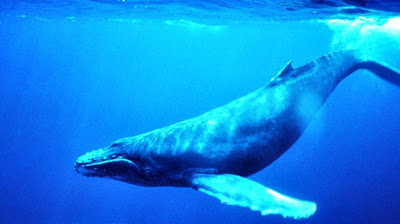
As it happens, our very first underwater whale encounter also was the most dramatic. Or perhaps it seems like that because like so many other 'first time' events in life, it left such a vivid and indelible memory.
Jerry and I were diving at Puako, Hawaii near a certain underwater promontory known as Snapper Point. At the top of Snapper Point, a narrow plateau juts seaward like a coral-covered peninsula. The top of the plateau begins at a depth of about 20 meters (65 ft), then the terrain slopes down steeply to a depth of nearly 40 meters (130 feet), where it levels off, more or less, into a sand flat. It always has been a favorite dive: Swim from shore directly to the base of Snapper Point, have a look around at the sand community for a few minutes, then begin a gradual ascent along the steep and rocky slope to the plateau, finally moving across the coral gardens toward the shallows and shore. It's a classic multi-level dive.
Because Snapper Point is sort of like the last outpost between the shore and the deep blue abyss, we often see big animals there. Sharks, eagle rays, mantas, amberjacks, barracuda, tuna and assorted pelagics cruise past Snapper Point frequently. We also see pods of dolphins in the area from time to time, and sometimes they see us, too, and dive down to look us over. In fact, the possibility of seeing big stuff is a main attraction for diving at Snapper Point.
Then one day at Snapper Point we saw the biggest of the big stuff.
On the day of our first whale encounter, we had completed the deepest part of our dive at Snapper Point, and we were coming slowly up the slope, poking lazily along, looking for shells and little critters on the rocky bank. Just like always.
We were a few meters below the level of the plateau when a shadow passed over us. We both stopped and looked up at the same moment -- just in time to see a full-grown Humpback Whale do a jackknife dive from the surface and glide down toward us. We were stunned.
The whale, which looked to be about the size of a city bus, leveled off just at our depth, at a spot maybe five meters in front of us. It stopped and held its position for a moment, pectoral fins akimbo, and with an eye the size of a basketball, it just looked right at us. I think we actually stopped breathing for a moment, and I'm sure that our eyes, too, were about as big as they could get!
Next the whale drew its pectoral fins in to its sides, banked slightly to its right, and began to glide away. Only when it completed its turn toward the blue did it move its huge tail to propel itself. The last we saw of it was the white undersides of its enormous tail flukes -- easily 10 or 12 feet wide (although we didn't exactly get to measure!) -- beating up and down gently but purposefully as it left us.
That was the end of that dive for us. We could think of nothing but the whale, so we ceased our underwater sightseeing for the day and headed toward the shallows and our exit point.
One of the most striking things about that encounter, beyond the fact that the whale came so close to us in the first place, was noticing how graceful and agile it was. You'd think an animal so large would just lumber about -- a bull in a china shop, as it were. What we saw suggested anything but clumsiness. The whale dived just as deep as it needed to in order to inspect us. Then it paused, motionless, with what any diver would recognize as excellent buoyancy control. And when it left us, it made what can only be described as a precision departure. No thrash, no clunky moves. Clearly it was exquisitely aware of -- and in control of -- its body position, and that of its fins and tail flukes. That is what was so impressive, and what burned into our memory.
While that was our most dramatic whale encounter, it was not the last. On a number of occasions since then, we have seen whales underwater. Most encounters have happened while we were in buoy mode (which I described in the previous whale post), positioned near a dropoff or near the top of Snapper Point, just waiting (and hoping) for the whales to pass by. Very often we would wait like that -- sometimes for up to an hour -- and see nothing but little fishies, or perhaps a manta as a consolation prize. But once or twice in a season a whale or two will swim past us at relatively close range, as if rewarding us for our dedication and patience.
Do they notice us? I have to say, yes, I believe they do. In some instances I have been completely certain that they noticed us. An example that comes to mind right away: Along with our friend Dan, we had spent about forty minutes one day, waiting in buoy mode over a certain dropoff, because we'd seen whales on the surface in that area, just as we were entering the water. It was a cold day, and eventually Jerry signaled that he was going to end his dive and swim to shore because he was too chilled. Dan and I were getting cold, too, but decided to remain at the dropoff awhile longer. Several more minutes went by, and then along came a pair of huge Humpbacks. They swam past, close enough that we felt turbulence. It was really exciting. Spontaneously and in unison, both Dan and I were 'punching the sky' in delight. And believe it or not, one of the whales slowed slightly and looked back at us momentarily, as if to say, "What in the heck is THAT?!"
We have learned something about when to expect a whale encounter, or more correctly, when not to. We have noticed that when we hear the whales vocalizing, we never see them, even when the sounds are so loud that we imagine they must be just feet away. Without exception, every time we have come face to face with a Humpback underwater, it has been during an interval of whale silence. We think, perhaps, that they just don't vocalize much while they are swimming. Of course, neither do we.
About the Photo : I've never been able to photograph a whale underwater. Either I haven't had a camera when the whales appeared, or else I had a camera but it was set up for macro. I chose the photo above from the NOAA Photo Library. According to the notation there, the photographer was Dr. Louis Herman, who has had a long career studying the behavior, sensory processes and cognition of cetaceans. It seems fitting that we use Dr. Herman's photo to illustrate our story: When I was a graduate student at the University of Hawaii (UH), several visits to the Kewalo Basin Marine Mammal Laboratory in Honolulu, which Dr. Herman founded, gave me my first exposure to cetacean behavior. Dr. Herman is now a Professor Emeritus at UH.
Note: This is the third post in a series about the Humpback Whales that winter in Hawaii. In case you have not seen them, you may want to have a look at the two earlier episodes:
I should mention at the outset of this tale that, since Humpback Whales are a protected species, it is unlawful to pursue or otherwise interfere with them, either from the surface or underwater. People, whether on boats or in the water as swimmers or divers, are forbidden to approach "closer than 100 yards of any humpback whale or closer than 300 yards of a humpback mother and calf," according to the law.
On the other hand, the whales themselves are oblivious to (and excused from) such regulations. If they decide to, they are free to approach us, instead of the other way around. And once in awhile they do just that!
As it happens, our very first underwater whale encounter also was the most dramatic. Or perhaps it seems like that because like so many other 'first time' events in life, it left such a vivid and indelible memory.Jerry and I were diving at Puako, Hawaii near a certain underwater promontory known as Snapper Point. At the top of Snapper Point, a narrow plateau juts seaward like a coral-covered peninsula. The top of the plateau begins at a depth of about 20 meters (65 ft), then the terrain slopes down steeply to a depth of nearly 40 meters (130 feet), where it levels off, more or less, into a sand flat. It always has been a favorite dive: Swim from shore directly to the base of Snapper Point, have a look around at the sand community for a few minutes, then begin a gradual ascent along the steep and rocky slope to the plateau, finally moving across the coral gardens toward the shallows and shore. It's a classic multi-level dive.
Because Snapper Point is sort of like the last outpost between the shore and the deep blue abyss, we often see big animals there. Sharks, eagle rays, mantas, amberjacks, barracuda, tuna and assorted pelagics cruise past Snapper Point frequently. We also see pods of dolphins in the area from time to time, and sometimes they see us, too, and dive down to look us over. In fact, the possibility of seeing big stuff is a main attraction for diving at Snapper Point.
Then one day at Snapper Point we saw the biggest of the big stuff.
On the day of our first whale encounter, we had completed the deepest part of our dive at Snapper Point, and we were coming slowly up the slope, poking lazily along, looking for shells and little critters on the rocky bank. Just like always.
We were a few meters below the level of the plateau when a shadow passed over us. We both stopped and looked up at the same moment -- just in time to see a full-grown Humpback Whale do a jackknife dive from the surface and glide down toward us. We were stunned.
The whale, which looked to be about the size of a city bus, leveled off just at our depth, at a spot maybe five meters in front of us. It stopped and held its position for a moment, pectoral fins akimbo, and with an eye the size of a basketball, it just looked right at us. I think we actually stopped breathing for a moment, and I'm sure that our eyes, too, were about as big as they could get!
Next the whale drew its pectoral fins in to its sides, banked slightly to its right, and began to glide away. Only when it completed its turn toward the blue did it move its huge tail to propel itself. The last we saw of it was the white undersides of its enormous tail flukes -- easily 10 or 12 feet wide (although we didn't exactly get to measure!) -- beating up and down gently but purposefully as it left us.
That was the end of that dive for us. We could think of nothing but the whale, so we ceased our underwater sightseeing for the day and headed toward the shallows and our exit point.
One of the most striking things about that encounter, beyond the fact that the whale came so close to us in the first place, was noticing how graceful and agile it was. You'd think an animal so large would just lumber about -- a bull in a china shop, as it were. What we saw suggested anything but clumsiness. The whale dived just as deep as it needed to in order to inspect us. Then it paused, motionless, with what any diver would recognize as excellent buoyancy control. And when it left us, it made what can only be described as a precision departure. No thrash, no clunky moves. Clearly it was exquisitely aware of -- and in control of -- its body position, and that of its fins and tail flukes. That is what was so impressive, and what burned into our memory.
While that was our most dramatic whale encounter, it was not the last. On a number of occasions since then, we have seen whales underwater. Most encounters have happened while we were in buoy mode (which I described in the previous whale post), positioned near a dropoff or near the top of Snapper Point, just waiting (and hoping) for the whales to pass by. Very often we would wait like that -- sometimes for up to an hour -- and see nothing but little fishies, or perhaps a manta as a consolation prize. But once or twice in a season a whale or two will swim past us at relatively close range, as if rewarding us for our dedication and patience.
Do they notice us? I have to say, yes, I believe they do. In some instances I have been completely certain that they noticed us. An example that comes to mind right away: Along with our friend Dan, we had spent about forty minutes one day, waiting in buoy mode over a certain dropoff, because we'd seen whales on the surface in that area, just as we were entering the water. It was a cold day, and eventually Jerry signaled that he was going to end his dive and swim to shore because he was too chilled. Dan and I were getting cold, too, but decided to remain at the dropoff awhile longer. Several more minutes went by, and then along came a pair of huge Humpbacks. They swam past, close enough that we felt turbulence. It was really exciting. Spontaneously and in unison, both Dan and I were 'punching the sky' in delight. And believe it or not, one of the whales slowed slightly and looked back at us momentarily, as if to say, "What in the heck is THAT?!"
We have learned something about when to expect a whale encounter, or more correctly, when not to. We have noticed that when we hear the whales vocalizing, we never see them, even when the sounds are so loud that we imagine they must be just feet away. Without exception, every time we have come face to face with a Humpback underwater, it has been during an interval of whale silence. We think, perhaps, that they just don't vocalize much while they are swimming. Of course, neither do we.
About the Photo : I've never been able to photograph a whale underwater. Either I haven't had a camera when the whales appeared, or else I had a camera but it was set up for macro. I chose the photo above from the NOAA Photo Library. According to the notation there, the photographer was Dr. Louis Herman, who has had a long career studying the behavior, sensory processes and cognition of cetaceans. It seems fitting that we use Dr. Herman's photo to illustrate our story: When I was a graduate student at the University of Hawaii (UH), several visits to the Kewalo Basin Marine Mammal Laboratory in Honolulu, which Dr. Herman founded, gave me my first exposure to cetacean behavior. Dr. Herman is now a Professor Emeritus at UH.
Note: This is the third post in a series about the Humpback Whales that winter in Hawaii. In case you have not seen them, you may want to have a look at the two earlier episodes:
- Tales of Whales: Humpbacks in Hawaii - includes a brief video of the whales, plus a link to a live web cam at Puako, where we dive. You may be able to see the whales for yourself if you are lucky!
- Tales of Whales: Vocal Visitations - tells of hearing the whales underwater, and includes a link so that you can listen to the whales' songs and vocalizations, just as we hear them underwater.
Labels:
adventures,
behavior,
Hawaii,
marine life,
marine mammals,
Pacific,
whales
Tales of Whales: Vocal Visitations
by B. N. Sullivan
Yesterday we introduced our readers to Hawaii's humpback whales (Megaptera novaeangliae), the huge marine mammals that frequent our waters in large numbers every year during the winter months. At this time of year, the whales' presence dominates in this part of the Pacific Ocean. Not only do we see them daily from the surface as they spout, breach, and slap the surface of the water with their fins and tail flukes, we hear them incessantly beneath the ocean's surface. And sometimes, if we are lucky, we see them underwater as well.
Mostly, we hear the whales. The term whale songs has been used for years to describe the humpbacks' vocalizations. At times they do indeed 'sing', but believe me, a lot of what we hear from the whales is not exactly melodious. They snort, they whine, they trill, they grunt and groan. They make assorted barnyard sounds.
They say "whoop, whoop, whoop" and then purr so loudly that the sounds resonate in a diver's body. When the whales are relatively close by, we can physically feel the sound waves their vocalizations generate, perceiving them as palpable vibrations in our own rib cages, in addition to hearing them.
We think of these events as vocal visitations by the whales. The term 'visitation' may suggest something akin to a spiritual experience in your mind. Without exaggeration, that is what the term is meant to evoke. It's impossible to experience these visitations without having an exquisite sense of awe, in the purest meaning of the word, and without feeling very privileged indeed.
Many, many times during our winter dives at Puako, the whale sounds have been so loud and persistent that they are completely distracting. At their loudest, the sounds are close to overpowering.
At such times there is really nothing to do but to settle on a sand patch somewhere to be still and just listen, because it's impossible to do or think of anything else. If there is nowhere safe or convenient to settle, we take up a posture that we call 'buoy mode,' which Jerry is demonstrating in the photo on this page. Buoy mode entails positioning oneself in the water column, suspended somewhere below the surface, but well above the bottom. The idea is to remain quiet and immobile. In this case we use buoy mode to listen to the whales in a kind of motionless meditation.
Sometimes we hear the calls of an individual whale. More often we are party to what clearly are conversations amongst a number of whales. But, almost without exception, every time we actually have seen whales underwater, the encounter has occurred during a period of silence on the part of the whales. Then out of the blue -- very literally in this case! -- there's a whale (or two or three), right before our eyes.
We'll tell you about some of our face-to-face encounters with humpback whales in Hawaii in our next regular post (after Wordless Wednesday!), but meanwhile we encourage everyone to visit The Whalesong Project to listen to the kinds of whale vocalizations that we hear all winter when we dive at Puako. When you get to the website, click on the phrase "We are bringing Whalesongs to the World" near the top of the page. Let the recording load in your favorite media player, and then sit back, close your eyes, and experience a humpback whale vocal visitation for yourself.
Yesterday we introduced our readers to Hawaii's humpback whales (Megaptera novaeangliae), the huge marine mammals that frequent our waters in large numbers every year during the winter months. At this time of year, the whales' presence dominates in this part of the Pacific Ocean. Not only do we see them daily from the surface as they spout, breach, and slap the surface of the water with their fins and tail flukes, we hear them incessantly beneath the ocean's surface. And sometimes, if we are lucky, we see them underwater as well.
Mostly, we hear the whales. The term whale songs has been used for years to describe the humpbacks' vocalizations. At times they do indeed 'sing', but believe me, a lot of what we hear from the whales is not exactly melodious. They snort, they whine, they trill, they grunt and groan. They make assorted barnyard sounds.
They say "whoop, whoop, whoop" and then purr so loudly that the sounds resonate in a diver's body. When the whales are relatively close by, we can physically feel the sound waves their vocalizations generate, perceiving them as palpable vibrations in our own rib cages, in addition to hearing them.We think of these events as vocal visitations by the whales. The term 'visitation' may suggest something akin to a spiritual experience in your mind. Without exaggeration, that is what the term is meant to evoke. It's impossible to experience these visitations without having an exquisite sense of awe, in the purest meaning of the word, and without feeling very privileged indeed.
Many, many times during our winter dives at Puako, the whale sounds have been so loud and persistent that they are completely distracting. At their loudest, the sounds are close to overpowering.
At such times there is really nothing to do but to settle on a sand patch somewhere to be still and just listen, because it's impossible to do or think of anything else. If there is nowhere safe or convenient to settle, we take up a posture that we call 'buoy mode,' which Jerry is demonstrating in the photo on this page. Buoy mode entails positioning oneself in the water column, suspended somewhere below the surface, but well above the bottom. The idea is to remain quiet and immobile. In this case we use buoy mode to listen to the whales in a kind of motionless meditation.
Sometimes we hear the calls of an individual whale. More often we are party to what clearly are conversations amongst a number of whales. But, almost without exception, every time we actually have seen whales underwater, the encounter has occurred during a period of silence on the part of the whales. Then out of the blue -- very literally in this case! -- there's a whale (or two or three), right before our eyes.
We'll tell you about some of our face-to-face encounters with humpback whales in Hawaii in our next regular post (after Wordless Wednesday!), but meanwhile we encourage everyone to visit The Whalesong Project to listen to the kinds of whale vocalizations that we hear all winter when we dive at Puako. When you get to the website, click on the phrase "We are bringing Whalesongs to the World" near the top of the page. Let the recording load in your favorite media player, and then sit back, close your eyes, and experience a humpback whale vocal visitation for yourself.
Tales of Whales: Humpbacks in Hawaii
by B. N. Sullivan
One of the most wonderful -- and wondrous -- things about diving here in Hawaii, is the fact that some 10,000 humpback whales (Megaptera novaeangliae) spend the winter months in our waters. During the winter months, we get to see them frequently on the surface, and once in awhile, underwater as well.
Our blogger friend Sheila put up a humpback whale video on her site yesterday, and it reminded us to share some whale tales with our readers. For openers, here's the video:
(If the video does not play or display properly above, click here to view it on YouTube.)
The humpbacks that come to Hawaii every winter are a part of the North Pacific population that spend their summers in Alaskan waters. They pass the summer feeding, mostly, and then migrate south to warmer waters in winter. Some of these whales winter in the eastern Pacific, near Baja California, while the rest come here to Hawaii. It is here that they mate, and where the mama whales who successfully mated the year before give birth to their calves.
The whales begin arriving for the season in late Fall. We usually spot the first ones some time between Thanksgiving and Christmas. The arrival of the whales is a big deal to those of us who live near the coast or spend time in the water. Neighbors vie to be the first to spot the whales as they arrive, and to spread the word, "They're here! They're here!"
We see them offshore frequently, throughout the winter. We see them spout when they come to the surface to breathe. As mammals the whales are air breathers, and even though they can hold their breath for quite a long time, they must come up to the surface regularly for air.
The humpbacks play near the surface, too. They slap the surface of the ocean with their tail flukes, or with their big, flat pectoral fins. They breach and frolic with one another. Quite often we see the mama whales with their youngsters breaching almost simultaneously -- a real sight to behold!
These are huge creatures, weighing over 40 tons at adulthood. Despite their mass, they are very agile in the water. In the video you'll see one whale manage to leap almost completely out of the water. We call that maneuver a "full pickle" -- a term based on an apt description we once heard: that the humpback whale sort of resembles a huge dill pickle, with ceiling fan blades for pectoral fins. I can't recall exactly where we heard that, but the image stuck, and we began referring to a full breach as a "full pickle."
Here's a link to a live web cam at Puako, where we dive most often, so you can see what we see from the shore. If you're lucky, you just may see some whales. (You can also see what our weather and ocean surface conditions are like, in real time!)
In the next post we'll tell you about some encounters we've had with humpback whales. Meanwhile, you can find out more about these incredible creatures at these recommended websites:
One of the most wonderful -- and wondrous -- things about diving here in Hawaii, is the fact that some 10,000 humpback whales (Megaptera novaeangliae) spend the winter months in our waters. During the winter months, we get to see them frequently on the surface, and once in awhile, underwater as well.
Our blogger friend Sheila put up a humpback whale video on her site yesterday, and it reminded us to share some whale tales with our readers. For openers, here's the video:
(If the video does not play or display properly above, click here to view it on YouTube.)
The humpbacks that come to Hawaii every winter are a part of the North Pacific population that spend their summers in Alaskan waters. They pass the summer feeding, mostly, and then migrate south to warmer waters in winter. Some of these whales winter in the eastern Pacific, near Baja California, while the rest come here to Hawaii. It is here that they mate, and where the mama whales who successfully mated the year before give birth to their calves.
The whales begin arriving for the season in late Fall. We usually spot the first ones some time between Thanksgiving and Christmas. The arrival of the whales is a big deal to those of us who live near the coast or spend time in the water. Neighbors vie to be the first to spot the whales as they arrive, and to spread the word, "They're here! They're here!"
We see them offshore frequently, throughout the winter. We see them spout when they come to the surface to breathe. As mammals the whales are air breathers, and even though they can hold their breath for quite a long time, they must come up to the surface regularly for air.
The humpbacks play near the surface, too. They slap the surface of the ocean with their tail flukes, or with their big, flat pectoral fins. They breach and frolic with one another. Quite often we see the mama whales with their youngsters breaching almost simultaneously -- a real sight to behold!
These are huge creatures, weighing over 40 tons at adulthood. Despite their mass, they are very agile in the water. In the video you'll see one whale manage to leap almost completely out of the water. We call that maneuver a "full pickle" -- a term based on an apt description we once heard: that the humpback whale sort of resembles a huge dill pickle, with ceiling fan blades for pectoral fins. I can't recall exactly where we heard that, but the image stuck, and we began referring to a full breach as a "full pickle."
Here's a link to a live web cam at Puako, where we dive most often, so you can see what we see from the shore. If you're lucky, you just may see some whales. (You can also see what our weather and ocean surface conditions are like, in real time!)
In the next post we'll tell you about some encounters we've had with humpback whales. Meanwhile, you can find out more about these incredible creatures at these recommended websites:
- Hawaiian Islands Humpback Whale National Marine Sanctuary - NOAA
- Getting to Know the Humpback Whale - The Dolphin Institute
Labels:
behavior,
Hawaii,
marine life,
marine mammals,
Pacific,
videos,
whales
Subscribe to:
Posts (Atom)

BNSullivan.jpg)
