Showing posts with label Pacific. Show all posts

A Beautful, Fragile Bryozoan Colony

Lace Bryozoan (Reteporelina denticulata)
Macro photo of a Lace Bryozoan (Reteporelina denticulata)
by B. N. Sullivan

This beautiful marine organism is a colony of Lace Bryozoa (Reteporelina denticulata).  Despite their appearance, Bryozoans are neither a coral nor a plant.  Taxonomically, the Bryozoa form a phylum all their own.  Most of the more than 4,000 species of Bryozoans live in the sea.

The name Bryozoa translates to "moss animal."  The individual animals that make up the colony are microscopic.  This species builds lacy calcareous structures of interconnected branches, made from the mineralized exoskeletons of thousands of tiny individuals.  The macro photo at the top of this page gives a good idea of how intricate and intertwined the branches can be.  It takes the colony of organisms a very long time to build these lovely structures.

The colonies are pretty, yet they are quite brittle and therefore very fragile.  If you come across a Bryozoan colony while diving, be careful not to touch it or bump it. The delicate structures will almost surely break if handled.

Almost all Bryozoans are sessile -- that is, the colonies are attached to some hard substrate like rock or hard coral.  The photo below shows a colony of Reteporelina denticulata growing on a hard coral (Porites lobata).  Once in awhile, a diver may come across a small Bryozoan colony that appears to be growing out of packed sand or mud, but closer inspection will almost certainly reveal that it is in fact attached to a rock or lump of coral rubble that is buried.

The Bryozoan species pictured here is rarely seen at depths of less than about 10 meters, but we have seen them on rocks below 40 meters.  In our experience, larger colonies are found at deeper depths -- perhaps because they are less likely to be disturbed and damaged by surge.

I photographed the Lace Bryozoan colonies shown here off the coast of Puako, Hawaii at depths between 20 and 30 meters.  The colonies pictured here are quite large for the species -- approximately four inches (10 cm) across.

Lace Bryozoan (Reteporelina denticulata)
Lace Bryozoan colony growing on coral in Hawaii


Basking Sea Turtles in Hawaii

Green Sea Turtle (Chelonia mydas), basking at Puako, Hawaii
by B. N. Sullivan

Imagine that you are in Hawaii, walking along near the edge of the ocean.  You come upon a sight like that in the photo at the top of this page -- a sea turtle lying on the sand or on the rocks.  You may notice that its carapace is dry, indicating that it has been out of the water for awhile. You may feel alarmed, wondering if it is stranded.  You think: Maybe a wave washed it ashore and it doesn't know how to get back into the ocean. Or perhaps it crawled out of the water intending to nest, but got stuck.

If it is a Green Sea Turtle (Chelonia mydas),  chances are very high that it has come ashore intentionally, it is not distressed or stranded, and it is not about to lay its eggs.  It is engaging in a behavior called "basking" -- another term for sun-bathing.

So far as anyone knows, only green sea turtles engage in this behavior, although no one is certain why they do it, or why they are the only sea turtle species who like to bask.  One proposed explanation for basking has to do with temperature regulation, since other kinds of reptiles are known to do this.  Another hypothesis is that basking ashore allows the turtles to rest for relatively long periods of time (hours) without risking predation, e.g., by sharks.

Regardless of the reason, Green Sea Turtles do come ashore regularly in many locations in the main, human-populated, Hawaiian islands, none of which are known to be nesting areas for this species.  They come ashore to bask in the sun.

So, if you come upon a turtle on the beach or rocks near a shoreline in Hawaii, what should you do?  You can watch them for awhile if you like -- just don't get close enough to disturb them.  You can photograph them, but please don't use a flash.  Don't try to move them or "help" them back into the ocean.  They need no assistance: when they are ready to go back to sea, they will do so unaided.  So don't block their path to the water, either!

Here are a couple more photos of basking turtles.  The first shows one turtle already basking while a second is preparing to "haul out."  The final photo shows a turtle who apparently has decided she has worked on her tan enough for the day, and is returning to the water.

Green Sea Turtles in Hawaii
Green Sea Turtles near the water's edge in Hawaii

Green Sea Turtle returns to the ocean after basking
A Green Sea Turtle returning to the ocean after basking
All of the basking sea turtles on this page were photographed at Puako, on the west coast of the Big Island of Hawaii.

For more information about this behavior of sea turtles in Hawaii, see:

Whittow, G.C., & Balazs, G.H. (1982). Basking behavior of the Hawaiian green turtle. Pacific Science, 36(2), 129-139 -  (11-page PDF)


Cerianthids: Marine animals that look like flowers


Cerianthid "tube anemone" - Hawaii
by B. N. Sullivan

The creatures pictured here look like anemones, but they are not true anemones.  They are Cerianthids, commonly referred to as ‘tube anemones’, which are taxonomically quite distinct from true anemones.

Cerianthids and true anemones do belong to the same phylum, Cnidaria, and the same class, Anthozoa, but tube anemones belong to the subclass Ceriantipatharia, a taxon that also includes the so-called ‘black corals’ (Antipatharia).

Dark-colored Cerianthid, Hawaii
One of the visible features that distinguishes Cerianthid tube anemones from true anemones is the morphology of their tentacles.  Cerianthids have shorter tentacles in their centers, and longer tentacles around the margin.  The color of the shorter tentacles usually is different from that of the longer tentacles, making them look a lot like flowers (at least to me).

White Cerianthid, Hawaii
Side view of a Cerianthid, showing its tube
Cerianthids dwell inside a rubbery tube (thus the name tube anemone) which is built from mucus secreted by the animal.  The tube is embedded in mud or packed sand. When not feeding, or when disturbed, the animal retracts inside its tube for protection.

These creatures can be difficult to photograph for several reasons.  Most Cerianthids are relatively small; their crowns of tentacles are perhaps 5 cm (2 in) across, so it’s necessary to get very close to them in order to photograph them.  If the photographer accidentally touches one of the tentacles, piff! the critter retracts.  And although Cerianthids happily feed in gentle currents, any nearby turbulence — like that created by the photographer as he or she moves about — causes the critter to quickly go into hiding.

These tend to be deep-dwelling creatures — all of the examples in this post were photographed at depths greater than 40 meters (130 ft).  They are accustomed to low levels of ambient light at those depths, so Cerianthids do not take kindly to blasts of artificial light from a camera strobe.  At best, one or two shots of an individual is all that a photographer can hope for before all that is left to photograph is the tube!

Cerianthid retracted into its tube
All of the Cerianthid tube anemones pictured in this post were photographed off the west coast of Hawaii’s Big Island.  This post was adapted from an article I wrote several years ago for ScienceBlogs.com.

Find the lobster in this photo


Sculptured Slipper Lobster (Parribacus antarcticus), Hawaii
by B. N. Sullivan

What you are looking at in the photo above is the ceiling of an underwater cavelet in Hawaii.  The bright red stuff is an encrusting sponge.  Most of the rest of the surface is covered by various kinds of algae.  The purplish blob in the center of all that red is not a clump of algae; it is a slipper lobster wearing a clever disguise.

This is the Sculptured Slipper Lobster (Parribacus antarcticus),  a member of the Scyllaridae family.  It is said to be the most common slipper lobster species found in Hawaiian waters, but if you polled a sample of divers there you would find that relatively few have seen these critters.  Part of the reason is that their camouflage makes them easy to miss, and their flattish profile also helps them to blend into the background.  In addition, they are rather small -- maybe five or six inches long at most.

The individual in the photos here was snuggled into a crevice in a cavelet we visited during a night dive at Puako, Hawaii.  We had been inside this cavelet many times during the day and often found pretty nudibranchs on the walls and roof surface.  Expecting that we might see some of those at night as well, we shined our lights all around as we entered.  We didn't find any nudibranchs that night, but as it happened, our bubbles hit the spot on the ceiling where this little slipper lobster was hanging out.  Annoyed, it skittered across the surface to escape the bubbles.  We hadn't noticed it until it moved, even though the beams from our lights had swept the area several times.

Below is another photo of the same creature.  Note the snazzy fringe along the edge of its carapace.  In case you are still scratching your head about what you are seeing, the little lobster is facing left in the photo below.  If you look very carefully you may be able to distinguish its widely spaced eyes from the rest of the mottling.

Sculptured Slipper Lobster (Parribacus antarcticus), Hawaii

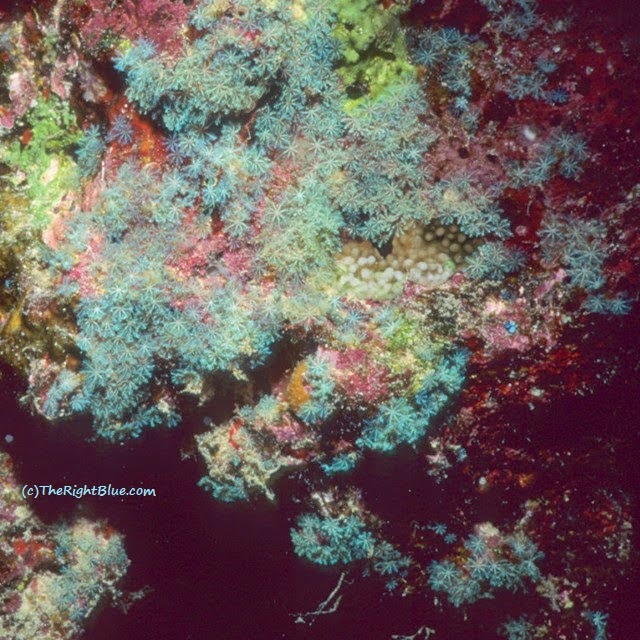
Blue Snowflake Coral (Sarcothelia edmonsoni), a Hawaiian endemic


Blue Octocoral (Sarcothelia edmonsoni), a Hawaiian endemic
Blue Snowflake Coral (Sarcothelia edmonsoni), a Hawaiian endemic Octocoral
by B. N. Sullivan

The underwater landscape in Hawaii is not known for the presence of soft corals. There are hard, stony corals aplenty on Hawaiian reefs, but the sea plumes, colorful Nephtheid soft corals, and sea fans found on most other tropical reefs around the world are largely absent in Hawaii.

The pretty blue Octocoral pictured above is one of relatively few soft coral species that live in Hawaiian waters.  Some soft corals in Hawaii are not seen by divers because they grow at depths beyond sport diving range.  Others, like this one, are overlooked more often than not.

It is easy for a diver to swim right past a patch of Blue Snowflake coral without noticing it.  The species is what we think of as a "low-rise" coral.  The colonies form mats on the surfaces of rocks and dead coral.  From a distance, the colonies look kind of "mossy."  You have to get in close to observe the tiny flower-like polyps, but once you spot those, there is no doubt that you are looking at an Octocoral.

Blue Snowflake Coral is a Hawaiian endemic, i.e., it occurs naturally only in Hawaiian waters.  Its scientific name is Sarcothelia edmonsoni, but it was formerly classified as Anthelia edmonsoni.  (If you are searching for information about the species, you may have to look up both names).  It is a member of the Xeniidae family.

Sarcothelia edmonsoni is the primary food source for another creature endemic to Hawaii, the sea slug Marionia hawaiiensis* (formerly known as Tritonia hawaiiensis).  It makes sense -- doesn't it? -- that an endemic critter would have another endemic species as its main prey.

I photographed this example of Sarcothelia edmonsoni along the South Kona coast of Hawaii's Big Island, near the edge of Honaunau Bay.
-------------------------------------------------------------

*I don't have a photo of Marionia hawaiiensis, so click here to see the creature on Cory Pittman and Pauline Fiene's site, Sea Slugs of Hawaii.


One Big Butterflyfish!

by B. N. Sullivan

Lined Butterflyfish (Chaetodon lineolatus)

This is the Lined Butterflyfish (Chaetodon lineolatus), perhaps the largest butterflyfish species in the world.  Adults measure about 30 cm (12 in) in length -- nearly twice the size of the majority of butterflyfish species.  The Saddle Butterflyfish (C. ephippium) is the only other butterflyfish species that approaches (and may sometimes match) the size of C. lineolatus.

This is an Indo-Pacific species widely distributed throughout the region.  We have seen them in the Red Sea and in Hawaii, but they are known to occur as well along the shores of East Africa, Southern Japan, and Australia's Great Barrier Reef.

We have observed them almost always in pairs.  They hang out around coral reefs, which is not surprising since they feed primarily on coral polyps.  It is not unusual to see a pair of these fishies bobbing along side by side as they peck away at a coral head.  According to the World Register of Marine Species (WoRMS) page on C. lineolatus, they also feed on anemones, small invertebrates, and algae.

Lined Butterflyfish are believed to be a long-lived species.  Although no one knows for sure how long their natural lifespan is, it is likely several decades.  In places like Hawaii where local divers may visit the same site again and again over years or even decades, the divers learn to recognize individual animals that live there.  We got to know a certain pair of C. lineolatus living in Honaunau Bay, on the South Kona coast of Hawaii Island and have seen them there again and again over a period of at least 15 years.

Honaunau Bay is a popular snorkeling and shore-diving  spot for tourists as well as locals, and many have fed the reef fish there over the years.  While guides and tour operators currently do a good job of discouraging this practice, the fish seem to have long memories.  The pair of Lined Butterflyfish in the image below still approach divers, ever hopeful for a hand-out.


Diver with Lined Butterflyfish
A diver interacts with some Lined Butterflyfish in Honaunau Bay, Hawaii


Video: Underwater junkyard off the California coast

by B. N. Sullivan

We've posted several articles about a nasty ocean environmental issue: marine debris.  Since this is one of our pet peeves, we have repeatedly reminded divers and beachgoers to deposit their trash in proper receptacles or to take it home with them.  Moreover, we have asked them to pick up and properly dispose of debris they find on the beach and in the water, including abandoned nets and fishing tackle, even if they did not put it there to begin with.

Being mindful about trash such as picnic remains and general litter can help to reduce damage to reefs, the pollution of waterways, and the risk of entanglement by marine wildlife -- and that's a good thing. But a much more serious and pervasive problem exists as well: using the ocean as a dump!

Have a look at this Fox News video, and you'll see what we mean:


If the video does not play or display properly above, click here to view it on YouTube.

Thanks to @scubadivergirls and Deep Sea News for alerting us about this video.

The Ornate Butterflyfish (Chaetodon ornatissimus)

by B. N. Sullivan

Fishes in the Butterflyfish family (Chaetodontidae) are among the prettiest inhabitants of tropical reefs around the world.  This species, the Ornate Butterflyfish (Chaetodon ornatissimus) is particularly nice looking, we think.

The Ornate Butterflyfish is easy to recognize, with six diagonal yellow-orange stripes on each side of its creamy body, black and yellow bars on the face (including one that covers the eye), a gray patch on its forehead, and black 'trim' around its margins.  They are said to grow to a length of 20 cm (about eight inches), although most of the adult individuals we have seen are somewhat smaller -- usually about 15 cm (six inches).

C. ornatissimus feeds exclusively on live coral polyps, so you would expect to find them in coral-rich areas. They seem to favor coral polyps of the Pocillopora and Montipora genera.  (Here in Hawaii, we frequently see them pecking on Pocillopora meandrina.)

Juveniles of this species look like cute miniatures of the adults.  The juveniles can be quite shy, hiding in corals for protection.  The juveniles live as singletons, but once they reach breeding age, they find mates and form pairs.  In fact, it is unusual to see an adult of this species not accompanied by its mate.  Also, pairs establish a home range, so once you discover a pair of C. ornatissimus, you will likely be able to find them again in the same area time after time.

'Ornates' are an Indo-Pacific species, most commonly found in the central and western Pacific, from Hawaii to Australia's Great Barrier Reef.  Sightings have been reported as well around Christmas Island in the eastern Indian Ocean, and we have seen photos of the species taken in Indonesian and Malaysian waters.  They are quite common here in Hawaii. I photographed the one pictured on this page in Honaunau Bay, on the south Kona coast of Hawaii's Big Island.

Whale Shark excitement on the Kona Coast

by B. N. Sullivan

In late February we posted an article about Whale Sharks (Rhincodon typus), with a video to illustrate. That video was shot at Christmas Island in the Indian Ocean. We now direct your attention to another Whale Shark video, shot a year ago on the Kona coast of Hawaii.

YouTube user dolphinmind, who posted this video of some very happy snorkelers' encounter with the Whale Shark, said:
A great day of Kona Coast snorkeling on Hula Kai turned unforgettable by an extremely rare 40 foot long whale shark encounter... Folks...no special effects or editing on this video...it's REAL. ...
Yep, and it's REAL BIG!


If the video does not display or play properly above, click here to view it on YouTube.

So, there was this tsunami in Hawaii...

by B. N. Sullivan

Here in Hawaii, the drama began on Friday evening, Feb. 26, 2010, while I was watching the Olympics on television.  As is usually the case when I watch TV in the evening, my mini netbook was on my lap, and I was playing a game on it.  In addition to the game, I had Twitter open in my browser -- not wanting to miss anything that might be happening somewhere in the world.  (I admit it: I'm a breaking news junkie!)

At exactly 8:36 PM Hawaii time, I saw the first mention on Twitter of a huge earthquake off the coast of Chile.  The first report said the magnitude was estimated to be 8.3.  A few minutes later, that estimate was changed to 8.5, and a tsunami warning was issued for Chile and Peru.  Roughly an hour after that, the magnitude of the quake was upped to 8.8, and it was announced that a tsunami had indeed been generated.

That was it for me.  I had no further interest in my game, the Olympics, or anything else on TV, save for the news.  I watched the story develop on TV and on the Web until about 3 AM, when I could stay awake no longer.  But by that time I knew that a tsunami was headed across the Pacific; that an official tsunami warning had been issued for Hawaii; that coastal evacuations would begin at 6 AM; and that the tsunami was projected to reach Hilo minutes after 11AM on Feb. 27.  Believing (correctly, it turned out) that most of my family members and friends on the Big Island already were asleep when the tsunami warning was initiated, I sent tweets and emails to them to give them a heads up about what we all would face when morning came.

Promptly at 6 AM -- right on schedule -- the civil defense sirens along the coast began to wail their warning to those who lived in inundation zones to prepare to evacuate.  The sirens warbled again, each hour on the hour, until 10 AM when roads along the coast, as well as those that led into and out of the inundation zones were closed.  Coastal evacuees traveled inland and upslope; vessels left the harbors and went far out to sea to wait in open water; some small craft were trailered inland for the duration.

We sat tight at our house, not needing to evacuate since we live on a hill at an elevation about 500 feet above sea level.  At 10:30 AM the final warning siren sounded.  I have to admit, it was a bit nerve-wracking.

We watched live coverage of the scene at Hilo Bay.  Everyone was nervous.  After all, the epicenter of the  present quake was very near that of another great quake in 1960, which generated a tsunami that wiped out much of downtown Hilo and claimed 61 lives.  In addition, people of our era have seen vivid images of the Boxing Day Tsunami that followed a huge earthquake off the coast of Sumatra on Dec. 26, 2004, which swept  across the Indian Ocean, killing hundreds of thousands of people.  All of this was on our minds, but no one knew exactly what to expect.

The predicted time of arrival for the tsunami came and went.  The webcam trained on Hilo Bay showed calm water, under a clear blue sky.  Several minutes later, however, the water began to flow out of the harbor into the bay.  As the water receded, the surface roiled, there were ribbons of foam, and the color of the water changed radically from transparent  blue to a very muddy, opaque brown.  Rocks and reeftops that had been submerged were now bared for a moment.  Then the water surged back toward the shore.

This cycle was repeated at least six or seven  times over the next hour and a half or so, and indeed, officials have said that smaller, less noticeable (to casual observers) surges continued for many hours.  When the tsunami warning was lifted, just before 2 PM, evacuees were allowed to return to their homes and businesses along the coast, but the beach parks remained closed.  Everyone was warned not to venture into the ocean, due to the possibility of unpredictable and potentially strong currents.

In Hilo Bay, the largest surge turned out to be just over one meter high.  There was no breaking wave, but the surge did wash over the breakwater, and briefly covered a dock in the harbor.  Although we did not witness it, we heard reports that the tsunami  swelled into the mouths of the two rivers that empty into Hilo Bay, surging upstream and turning the river waters very muddy.  As the mass of sea water pushed into the rivers, it uprooted vegetation along the river banks, and carried it back out to sea, along with rocks and other debris from the river bottoms.  Fortunately, though, the surge was insufficient to cause it to overflow the bay and the harbor to an extent that caused damage.  Hilo was spared, and so were all the other coasts of the Hawaiian Islands.

We don't have tsunami alerts very often, and the number of times a tsunami has reached our shores is relatively small.  Still, there have been several instances in which a tsunami large enough to do damage did come ashore in Hawaii, did cause destruction, and did cause injury and loss of life.  Island residents take tsunami alerts very seriously.

We have warning sirens on all of our coasts, and people know that when the sirens sound, they should immediately head inland and/or upslope and ask questions later!  Indeed, during yesterday's event, there were no reports of people who did not cooperate with the evacuation order.

For more information about the tsunami hazard in Hawaii, visit the Pacific Disaster Center's Tsunami page.  For tsunami alerts and data, visit the Web site of the Pacific Tsunami Warning Center, where you can also sign up for email alerts or subscribe to an RSS feed that will bring you alerts in real time.

Mushroom corals: Solitary corals of the Fungiidae family

by B. N. Sullivan

Fungia scutaria
Do the images on this page remind you of mushrooms?  The corals pictured here belong to the Fungiidae family.  Note that the family name has the same word root as the English word 'fungus', and these corals are known by the common name Mushroom Corals.

Although the appearance of these corals may look similar to the underside of a mushroom cap, the resemblance stops there.  These are stony corals; they are not soft.

While most hard coral species live as colonies of  polyps that aggregate and form calcareous structures, most species of corals in the Fungiidae family live as solitary corals rather than as colonies.  In addition to being solitary, most of the corals in this family are free-living -- that is, they are not attached to the substrate.

The photos on this page show two examples of solitary, free-living corals from the Fungiidae family.  Both of these are Indo-Pacific species, widely distributed across the region from the Red Sea in the west, to the islands of the central Pacific.  Both of the corals shown here were photographed in Hawaii.

The image near the top of this page is Fungia scutaria, the most common mushroom coral in Hawaiian waters.  F. scutaria also is the largest of the mushroom corals found in Hawaii.  It typically grows into an oblong or oval shape that can reach a size of about seven inches (18 cm) in length, although most of the individuals we have seen are about half that size.

Cycloseris vaughani
The second photo shows Cycloseris vaughani, a smaller mushroom coral species.  Cycloseris corals are more circular or discoid in shape.  Adults of this species grow to a diameter of about two inches (5 cm).

Both of these species begin the post-larval stage of their lives attached to the substrate by a stem-like structure.  As the juveniles mature and take on their adult form, the stem gradually dissolves, and they become free-living adults.

Mushroom corals usually are found in sandy areas near the base of stands of reef-building corals, and on rubble slopes at  the outer edges of fringing reefs.  They are found less frequently in shallow areas where they would be subject to being tumbled about by waves and surge.  They prefer more sheltered environments.

Mushroom corals are known to feed on plankton and the metabolic by-products of the symbiotic algae that live in their tissues, but a team of Israeli scientists carrying out a reef survey in the Gulf of Aqaba (Red Sea) recently witnessed mushroom corals feeding on -- of all things -- rather large jellyfish!  They documented the species Fungia scruposa feeding on a Moon Jelly (Aurelia aurita). You can read about this amazing discovery in this article (with photos) published by the BBC:  Predatory coral eats jellyfish.

See also: Alamaru, A, et al. (2009). Opportunistic feeding by the fungiid coral Fungia scruposa on the moon jellyfish Aurelia aurita. Coral Reefs. DOI: 10.1007/s00338-009-0507-7

Video: Turtle-watching at Puako, Hawaii

by B. N. Sullivan

I'm traveling on the U.S. mainland right now.  A change of scene can be a good thing, but I do miss the ocean when I'm away from the islands.

This evening I logged on to Twitter to catch up with news from here and there, and what do you suppose I discovered?  Someone I follow on Twitter just happens to be vacationing right now in Puako, Hawaii.  Looks like we have temporarily traded places.  Small world...

Judging by her tweets, Michelle and her family are enjoying their time on the Big Island.  Here is some evidence: a video of Hawaiian Green sea turtles (Chelonia mydas) lazily pottering about in the shallows at Puako, shot by Michelle's son.


If the video does not play or display properly above, click here to view it on YouTube.

Related:  Our page about Hawaiian Green sea turtles, and our page with links to all of our stories, photos, and videos of several sea turtles species.

Same or different?

by B. N. Sullivan

Butterflyfishes
This image reminds me of those puzzles: Which one is not like the others?

At first glance, all the fishes in the photo look alike.  They're similarly shaped, their bodies are white with lines, and they all have yellow fins and black trim, including a black bar over the eye.  But if you look more carefully you will notice that there actually are two species of Butterflyfishes swimming together.

The two fishes in the foreground of the photo -- the ones with the black spots near the trailing edge of their dorsal fins and the diagonal lines on their bodies -- are Threadfin Butterflyfish (Chaetodon auriga).

The larger fish in the upper part of the photo is a Lined Butterflyfish (Chaetodon lineolatus).  Note that it has a broad black arc on its back, instead of a spot, and the lines on its body are vertical rather than diagonal.  (And yes, that's another Lined Butterflyfish behind the two Threadfins.)

Both of these are Indo-Pacific species, and they are widely distributed.  We have seen them -- usually in pairs -- in many locations from the Red Sea all the way to Hawaii.  The ones here were photographed in Honaunau Bay, Hawaii.

Earlier we posted close-up images of each of these species.  If you take a look at those earlier photos of the Threadfin Butterflyfish and the Lined Butterflyfish, you will be better able to appreciate the differences in their markings.

So, if you see a pretty Butterflyfish -- white, with lines on its body, and with yellow and black trim -- now you know which details to look for that will distinguish the Threadfin Butterflyfish from the Lined Butterflyfish.

Hawaii's Milletseed Butterflyfish (Chaetodon miliaris)

by B. N. Sullivan

Chaetodon miliaris
Here's another Butterflyfish from Hawaii. This one is called the Milletseed Butterflyfish (Chaetodon miliaris), although you also may see it identified in some picture books as the Lemon Butterflyfish. Which common name you prefer may depend on whether you focus on its lemony background color, or its vertical rows of black spots.  The scientist who named the species focused on the spots, which he thought resembled milletseeds, hence  the species name miliaris.

Like the Multiband Butterflyfish (Chaetodon multicinctus that we presented in the previous post, C. miliaris is a Hawaiian endemic species.  In fact, the two species are closely related, both belonging to the subgenus Exornator. Nevertheless, the behavior of the two species is different in several ways.

Most conspicuously, the Milletseed Butterflyfish lives in aggregations instead of in pairs, and they are not territorial. It is not uncommon to see whole mobs of these bright yellow fishies moving along the reef together, looking for food.  Now,  "mob" is hardly a scientific term, but it suits shoals of Milletseed Butterflyfish.  Unlike some other fishes that school and move along in an orderly way, almost in unison, the Milletseeds move along together in an almost rowdy fashion -- but  I must say, that is a wonderful sight to behold.

Milletseed Butterflyfish have a much more varied diet than C. multicinctus. Their preferred food is zooplankton, but they also will eat the eggs of other fishes -- especially those of fishes that deposit egg masses on rocks and other surfaces.  Milletseeds sometimes perform as cleaners of other fishes, too.

The Milletseed Butterflyfish occurs naturally only in Hawaii, but it is not rare in the islands.  In fact, C. miliaris is said to be the most common among the 24 species of the Butterflyfish family (Chaetodontidae)  found in the Hawaiian islands.  If you dive or snorkel in coral reef environments in Hawaii you are almost certain to encounter a 'mob' of these yellow beauties.

The Multiband Butterflyfish (Chaetodon multicinctus), a Hawaiian endemic fish

by B. N. Sullivan

Chaetodon multicinctus
We'd like to introduce our readers to the Multiband Butterflyfish (Chaetodon multicinctus). This species is endemic to Hawaii and Johnston Atoll, i.e., it isn't found naturally anywhere else in the world.

These fishies are rather small -- about 10 cm (4 in) in length -- and their natural diet consists solely of coral polyps, especially those corals in the Poritidae family. The fish in the photo on this page is about to feed on a head of Porites lobata, a common stony coral on Hawaiian reefs that seems to be a favorite food of C. multicinctus. They feed by pecking on the coral head, extracting individual polyps.

C. multicinctus is a plentiful species on most coral reefs in Hawaii, and they are seen frequently by divers.  They don't shoal. or school; instead they live as monogamous  pairs that remain together over long periods of time, perhaps for life.  In case you are wondering, no one knows for sure how long 'life' is, but one researcher we know who studied this species told us their natural lifespan may be in the neighborhood of 15 years (providing they don't get eaten!).

These guys are quite territorial. Observational studies of the species in its natural environment have shown that pairs establish territories of 50-100 square meters.  Once established in their territory, a pair will remain there together and defend it from potential competitors,  actively aggressing against intruders of the same species.   Some pairs have been observed maintaining the same territory for periods greater than four years.  It's possible that they stay in the same territory for a lifetime, but again, no one has systematically observed a given pair longer than four or five years.

Like virtually all species in the Butterflyfish (Chaetodontidae) family, C. multicinctus is diurnal.  That is, they are active throughout the daylight hours, and at night they hide in crevices in the reef to take their rest.

By the way, some fish identification books and cards identify C. muticinctus by its alternative common name, Pebbled Butterflyfish.  Presumably that name refers to the vertical rows of speckles on the fish.  We also have seen it referred to as the Brown-barred Butterflyfish.  We prefer the common name Multiband Butterflyfish, since it is a literal translation of the fish's species name multicinctus.  (Or, as we often advise, avoid the confusion of variable common names.  Just learn the scientific name and be done with it!)

Note: For readers who may be interested in territorial behaviors and intra-specific communication by C. multicinctus, we recommend you have a look at: Tricas, TC, et al. (2006). Acoustic communication in territorial butterflyfish: test of the sound production hypothesis.  Journal of Experimental Biology, 209 (24), 4994-5004.

Hawaii Marine Debris Action Plan: Much needed program is the first in the nation

by B. N. Sullivan

Marine debris
Yesterday was an important day in the world of ocean conservation, and particularly for Hawaii.   The U.S. National Oceanic and Atmospheric Administration (NOAA) officially rolled out its new Marine Debris Action Plan (MDAP) for Hawaii -- the first in the nation.  Implementation of the MDAP is intended to protect Hawaii's coastal communities and marine life from the thousands of pounds of marine debris that wash ashore each year, just like that in the photo at right. [Photo supplied by NOAA].

The new MDAP is described as "a comprehensive long-term plan to actively assess and remove plastics, derelict fishing gear, and other human sources of marine debris from coastal waters and coral reefs along the island chain."  The plan, which was developed as a cooperative effort among NOAA; federal, state and local government agencies; academic institutions; conservation organizations; private industry; and community groups, aims to provide a comprehensive framework for activities to reduce:
  • the current backlog of marine debris
  • the number of abandoned and derelict vessels
  • land-based debris in waterways, and
  • fishing gear and solid waste disposal at sea
According to NOAA: Numerous strategies and activities fall under each of these goal areas, many of them already underway by Hawaii’s marine debris partners. These include debris removal efforts, emergency response, prevention and outreach campaigns, as well as increasing research and technology development. Progress will be tracked and measured for each of these areas.

These efforts are very welcome, and we are so pleased that the Hawaii Marine Debris Action Plan is now formally implemented.  Marine debris is a global problem, of course, and we hope that the Hawaii MDAP will serve as a model for similar efforts elsewhere.

For more information about the new program: Hawaii Marine Debris Action Plan (HI-MDAP) - 2 page 'pdf' file

Also visit the NOAA Marine Debris Program on the Web for related information, photos, and videos.

[Photo Source]

NOTE: This article was included in the February 2010 Carnival of Aloha, a blog carnival with a Hawaii theme. Have a look: Preservation and Lots of Aloha Create an Interesting Carnival

Related posts on The Right Blue:

Serene Waipiʻo Valley on Hawaii's Big Island

Waipiʻo Valley

by B. N. Sullivan

This is the mouth of the WaipiĘ»o Valley, situated on the northeastern coast of Hawaii's Big Island, in the Hamakua district.   The remote valley is historically important as the childhood home of King Kamehameha I, but we think its greatest virtue is its stunning natural beauty.  The valley is about a mile wide at the coast, and is surrounded by steep cliffs that rise up to 2,000 feet from the valley floor.  WaipiĘ»o Valley extends inland for roughly five miles, and features hiking trails, streams, and waterfalls -- including  the 1,300 foot high HiĘ»ilawe Falls.

This photo was taken from the WaipiĘ»o Valley Overlook.  From this vantage point you can see the surf breaking on the black sand beach that forms the seaward edge of the valley.  The Overlook is near the top of the narrow, rugged road that descends into the valley.  Not only is the sole road into WaipiĘ»o Valley narrow, it is very steep -- a 25% grade -- requiring four-wheel drive.  It takes about a half hour to carefully descend into the valley from this overlook point.

As residents of Hawaii's Big Island, we may be prejudiced, but one thing we can say about our island home is that it's a feast for the eyes, don't you think?

Butterflyfishes on a North Kohala reef

by B. N. Sullivan

Butterflyfishes
Of all the reef fishes in Hawaii, those that belong to the Butterflyfish family (Chaetodontidae) are perhaps the most colorful and easy to recognize.  About two dozen species of butterflyfishes live in the waters around the Hawaiian Islands.  The photo at right shows two of those species. [Click on the photo to enlarge.]

This photo is dominated by a grouping of Pyramid Butterflyfish (Hemitaurichthys polylepis).  Their common name refers to the triangle-shaped white patch  that covers most of their bodies.  These plankton eaters tend to aggregate over stands of coral during daylight hours, just as you see in the photo.  Pyramids are native to the central and western Pacific Ocean.

In the lower left quadrant of the photo are some Milletseed Butterflyfish (Chaetodon miliaris), named for the vertical rows of black seed-like dots on their otherwise yellow bodies.  They also sport a prominent black ocular bar (eye-stripe) and a black blotch at the base of their tails (i.e., the caudal peduncle).  They, too, eat plankton, but sometimes a diver or snorkeler will see a Milletseed Butterflyfish cleaning other fishes.

The Milletseed Butterflyfish is a Hawaiian endemic species -- that is, they are found naturally only in the Hawaiian Islands.  They are quite plentiful along coastal reefs, so if you snorkel or dive in Hawaii, you are very likely to see these fishes.

The photo on this page was taken at Big Sandy, a dive site located a few miles north of Kawaihae, on the North Kohala Coast of the Big Island.

Humpback whales returning to Hawaii for the winter season

by B. N. Sullivan

We're at the start of Humpback whale season here in Hawaii. Every autumn, large numbers of Humpbacks (Megaptera novaeangliae) migrate from their summer feeding grounds in the north Pacific to the waters around the Hawaiian Islands, where they then spend the winter. Those of us who live in Hawaii tend to feel a bit possessive about the north Pacific stock of Humpbacks, because they are born and bred in our waters.  Over the course of their winter stay in Hawaii, the big cetaceans mate, and the females who became pregnant the year before give birth to their calves.  In spring they all migrate north again

Although we haven't yet seen this year's Humpbacks here on the Kohala Coast of the Big Island, the first whales of the season were spotted recently near Maui. That means we can expect to see them here on our coast any minute!

Earlier this month some lucky folks on an Oceanic Society whale watching boat near the Farallon Islands, 25 miles west of San Francisco, had an amazing encounter with some Humpbacks. Four friendly whales "approached the boat and for over an hour circled the boat, nearly brushing up against it, and seemed to make contact with the 45 passengers on board."

Here is the Oceanic Society's video of that exciting encounter:


If the video does not play or display properly above, click here to view it on YouTube.

Hawaiian Green Sea Turtle at Honaunau Bay, Hawaii

by B. N. Sullivan

Here is a large image of a Hawaiian Green sea turtle (Chelonia midas) -- posted back-to-back with our previous post of a Hawksbill turtle (Eretmochelys imbricata), so that our readers can compare the features of the two species. Like the Hawksbill in the previous photo, this Hawaiian Green also was photographed at Honaunau Bay on the southeastern coast of Hawaii's Big Island, however the photos were taken on different days.